Your child will love the following games, they will help him to stimulate his senses and develop further.
0-3 months

Copycat
Your baby loves to imitate you and especially what you can do with her face: Stick out their tongue, grin widely, open their mouth wide, raise and lower their eyebrows, etc.
Babies at this age are best able to look at things at a distance of approx. 20-35 cm. You should therefore hold your child in front of you or bring your face up to this distance. Make slow movements and wait to see if it copies you. This may take some time, but most children are happy to try.
Tickle songs
You may already know nursery rhymes that involve various movements and tickling certain body parts, but if not, you can also make them up to other nursery rhymes. Sit your baby upright on your lap and touch the body parts in question, i.e. fingers, toes, lift his arms or legs. The best results are achieved with repetition, because babies love to know what's coming next. You will start giggling and laughing with anticipation even before you touch it. This is also very useful memory training.
Rum balls
At around three months, your baby can already hold his head up on his own and lift it slightly when lying on his tummy. Roll a coloured ball in his direction and let it stop about one metre in front of him. Your baby will fixate on the ball and may even try to move towards it. This exercise helps to strengthen his neck muscles, as well as his arms and legs. Give him the ball as a reward before he gets frustrated at not being able to reach it.
3-6 months
Catch me
Let an attractive soft toy hang from a ribbon in front of the baby. It will try to grab it, always praise it for doing so. The fun factor is even greater if the animal squeaks when squeezed, which will be all the more incentive to reach for it. This trains the coordination of hands and eyes.
Small talk
If your baby makes noises and little gurgling giggles, you should copy them. This stimulates his speech development. Also repeat the vowels and sounds that he says, answer "ahhh" with "ahhh". You can also change the length, e.g. after a long "bahhhh" say a short "ba", or add another vowel, e.g. "oh-ba".
Soap bubbles
All children love soap bubbles, which are so beautifully colourful. Place your child in front of you in a baby bouncer or car seat and let the bubbles fly around them without hitting their face directly so that they don't burst in their eyes. Your baby will follow the bubbles with his eyes until they land on the floor. Of course, you can also do this outside. Your child will learn a lot about cause and effect.
Puppet theatre
Make little finger puppets from an old glove and stick funny faces made of felt or pieces of fabric on them, with mouths, ears and noses. Let them dance and sing in front of your baby's eyes, tickle them and give them little kisses with the puppets. Your child will be thrilled, the more you pretend the dolls are alive, the better.
Out and in
Prepare a plastic box with small toys, e.g. building blocks, soft toys, rattles or plastic cups. Let your baby pack and unpack the container, one of his favourite activities. Help him as much as necessary. This will give his motor skills a good workout.
Adventure playground
An adventure playground is quickly constructed from cushions and other obstacles for the baby to crawl over. This will develop his strength, balance and coordination. At the end of the course you can place a colourful toy as an incentive. Help him as much as necessary to avoid frustration.
9-12 months
Play football
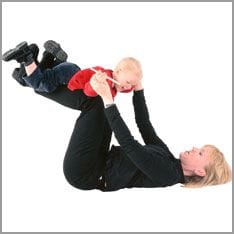
Your baby doesn't need to have learnt to walk to play football. Place a ball in front of you and grab it under the arms so that it can hover over it. Now let your child dangle over the ball and give them the opportunity to hit it with their feet. You can cross the whole room together, which will make your baby proud when he sees how far he has travelled with the ball. This exercise is particularly suitable for training his leg and abdominal muscles, even for the real football.
High towers
Build up empty cornflakes packets into a tower, or soft books, plastic bowls and so on. Then knock them over together with your baby. He will really enjoy it and learn about shapes and sizes through play.
Look here!
Now you already know that your child loves to imitate things. If they watch you combing their hair or washing their face, they will imitate this behaviour too. This behaviour can also be transferred to other parts of the body: clap your hands, thighs and hips, place your hands on your head and cover your face with them, or puff out your cheeks and then burst them with a finger. Let your imagination run wild and stimulate your child's.
Games and ideas for babies under one year old.
Babies,games,play,stimulate,'3 months','6 months',tickle,football,imitate,catch,grimaces,playground,puppet theatre,parents,'mother and child','shapes and colours'