Safety should be a major issue, especially during the first few years of a child's life. Babies and toddlers explore everything with all their senses, feeling, smelling, tasting, grasping and examining everything that comes their way. This innate curiosity is a means of becoming an independent living being, but unfortunately it is also associated with risks.
The aim here is to provide a checklist that you can use to make your child's environment safer so that the risk of injury is minimised.
- Room

It is best for a crawling child to be allowed to spread out and move around independently in a certain area, so its environment should be designed to be safe:
Doors should not be able to simply slam shut because little fingers could find themselves between the door and the hinge.
Fit doors to the outside with safety devices.
Table edges can be fitted with home-made protectors, but you can also buy them ready-made in the shops.
There are also safety devices on the market to prevent windows from being opened if you live high up with small children.
Drawers also need to be secured or dangerous objects removed.
Protective caps for sockets are easy to fit.
A night light in the room prevents the toddler from hurting himself in the dark if he gets up.
The key should be removed from certain cabinets.
Poisonous houseplants must not be within reach of small children.
Check how tip-proof the chairs and armchairs in your home are to avoid accidents.
Porcelain and ceramics should also be kept out of reach of children's hands, at least at the beginning.
A highchair must have straps or a bar to prevent the baby from slipping out.
A mosquito net over the bed is a good idea in summer.
A baby monitoring device is also a very sensible purchase.
- Kitchen
Children love to imitate things. But what mum does in the kitchen can be dangerous. To divert the child's interest from the real objects, you can give them their own frying pan, spoon, lid, etc. with which they can play at cooking.
Knives and scissors must of course be kept out of reach.
The oven and hob can be fitted with commercially available protective devices.
- Bathroom/WC
Children love playing with water, but unfortunately this element also harbours its dangers.
Bath mats should be non-slip.
Use shampoo that does not sting the eyes.
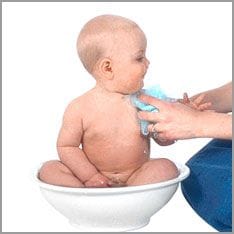
A special baby bathtub is more suitable for small babies as it is safer.
There are regulators for taps that do not allow the water to be turned on too hot.
Medication must be kept out of reach.
- Balcony, terrace and garden
There are also dangers outside the home that need to be taken into account.
Remove poisonous plants if possible.
Ponds and swimming pools must be secured with a fence.
If there is a direct path to the street, children should only play in the garden under supervision.
- Travelling with the baby
Car seats should always be approved for the age group.
Even on the shortest journeys, the baby or toddler must be firmly strapped into their seat.
When spending time in the sun, a high protection factor sun cream should always be selected.
Young children under the age of two should never go directly into the sun.
Insect repellent can be used against mosquitoes, but it should be noted that children's skin does not tolerate harsh products.
- Toys
Toys should be appropriate for the age group.
Colours and materials should be free of harmful substances.
The warning: Caution, small parts, not suitable for children under 3 years, should be taken seriously as they can swallow parts.