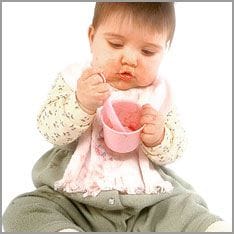
There are many pages on this topic on the Internet, books and brochures that can be obtained from independent retailers, consumer advice centres and various other institutions.
The most important questions a mother will ask herself when starting solid foods are as follows.
When exactly should I start complementary feeding?

- The WHO (World Health Organisation) recommends not starting complementary feeding until the end of the 6th month.
- If you notice that the baby does not seem to be getting enough from breastfeeding or the bottle alone.
- If the baby shows a strong interest in the food of other family members.
The baby's digestive system is now ready to accept more solid foods. However, if you want to wait a little longer and continue to breastfeed exclusively, for example, you can do this until the 7th month, but from the 8th month onwards, the baby's nutritional requirements change to such an extent that milk alone no longer provides the necessary substances.
Which fruit or vegetables should I start complementary feeding with?
Opinions are divided here, some advise starting with fruit, others with vegetables. You can't really do anything wrong, but you should bear in mind that you should only introduce one new food per 3-4 days in order to detect intolerances and allergy symptoms as early as possible.
The following types of fruit and vegetables are particularly suitable for starting complementary foods, preferably depending on the season:
Carrots
Potatoes
Fennel
Pumpkin
Courgette
Kohlrabi
Cauliflower
Broccoli
A little later, meat or fish and egg are added and everything can be combined, whereby 1-2 types of vegetables plus meat and potato are sufficient.
Apples
Pears
Bananas
Blueberries
Apricot
Cereals can be mixed into a fruit porridge or into whole milk porridge, the classic version.
How do I proceed with the introduction of complementary foods?
Initially, only one meal a day is replaced by porridge, so in the 7th month, for example, a vegetable and potato porridge at lunchtime, with or without meat, or alternating fruit porridge.
In the next month another meal, e.g. a milk-cereal porridge in the evening. In the 9th month, e.g. in the afternoon, a milk-free cereal-fruit porridge, and in the 10th-12th month round off the morning milk intake with a bread meal or milk-cereal porridge.
It is important that a little oil is added to the porridge so that the vitamins can be utilised; butter can also be used for fruit porridge to give it more flavour. A little fruit juice should also always be mixed into the vegetable and cereal porridge. At the beginning everything should be finely pureed, from the 8th month onwards it can be a little coarser.