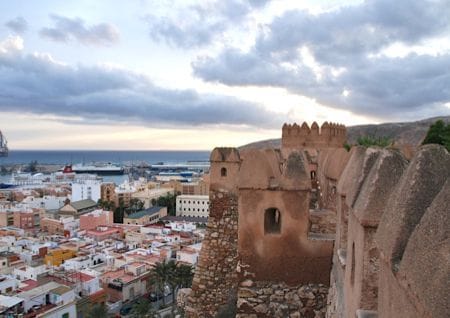
High above the city of Almeria in the Spanish region of Andalusia, the proud palace, the Alcazaba, overlooks the old town and harbour bay. Over the centuries, the Alcazaba has been frequently altered, which gives today's overall impression of the historical monument its exotic charm.The palace is undoubtedly the most impressive medieval building in al-Andalus.

The Alcazaba dates back to the time after its foundation by Abd al-Rahman III in the 10th century. In the middle of the 12th century, the city temporarily fell into the hands of the Christians. Although Christian rule only lasted 10 years, this was quite a setback for the city of Almeria and the Moorish Palace.
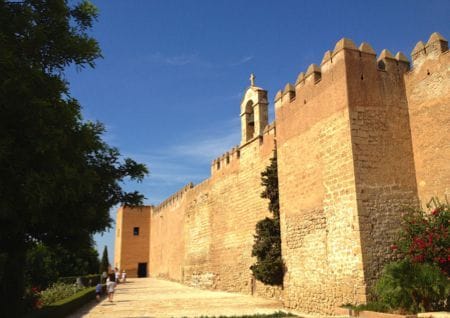
Ascent to the Alcazaba
The Alcazaba underwent the greatest structural changes during the Nasrid period between 1230 and 1492. New gates were built and other structures were added. In 1489, the Christian monarchs reconquered Almeria for the long term. While the Alcazaba had previously served as a seat of power, from then on it took on a military role.
In the meantime, the city of Almeria had become the maritime border with North Africa and therefore retained an important strategic role. However, due to the earthquake in 1487, the Alcazaba was in a deplorable state at the time and had to be heavily remodelled.
At the western end of the palace, the Catholics built a new, triangular section on the structures of the old Islamic palace. The new section improved the defence capability, as the development of artillery made new strategies necessary. At the same time, the new building represented the image of Christian power. The triangular shape symbolised the trinity of the Catholic faith.
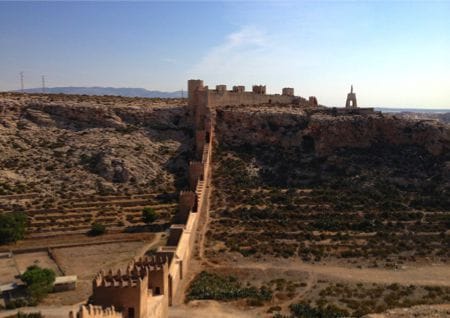
Jairán Mauer
Today, the Alcazaba is considered an archaeological masterpiece. The traces left behind by different eras and rulers allow interesting conclusions to be drawn about life in the city of Almeria at that time.
The castle is divided into three main parts. The first part is entered through the Puerta de la Justizia below the Torre de los Espejos, which towers over the entrance. The Baluarte del Saliente now houses the administration of the palace. You walk past the north wall and the Muro de la Campana. At the end of the beautifully landscaped gardens are the north and south towers.
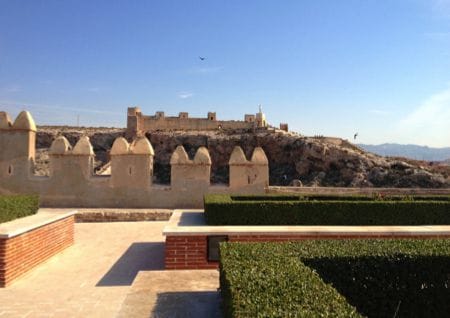
View of San Cristobal from the gardens
The second part begins at the cistern (Aljibe Califal). There you will find the San Juan church and the mayor's house (Casa del Alcalde), the former baths and the exhibition centre. Here you can see archaeological remains.
The third part is the aforementioned Christian Castle. The triangular parade ground is overlooked by the Torre de Homenaje and enclosed by the Jairán Wall.
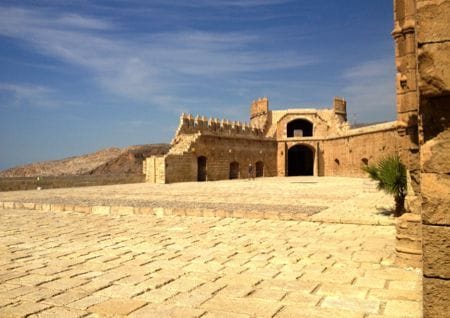
Parade ground in the Christian castle