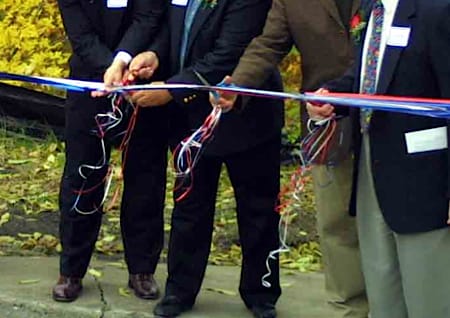
When public buildings or streets are inaugurated, a ribbon is often cut with scissors. What is the origin of this custom?

For centuries, the ribbon-cutting ceremony has symbolised a new beginning, similar to many wedding customs.
Cutting a ribbon has long been a custom at wedding celebrations in Europe. In France, the bride traditionally often cuts ribbons that block the groom's path to the church. This custom is a symbol of overcoming obstacles in marriage. In Italy, a ribbon is tied in front of the bride and groom's door, which the father of the bride cuts. This symbolises a newfound freedom for the newlyweds.
Just as ribbon cutting at a wedding symbolises a new beginning, this custom for the inauguration of a building or a street means that it is now open to the public. Often the ribbon is stretched in front of the entrance to indicate that the building behind it is waiting to be presented to the public.
In modern times, ribbon-cutting ceremonies began to appear towards the end of the 19th century. Archives report such a ceremony for the opening of a railway line in Louisiana, USA in 1898, and they became more common in the early 20th century. The World Trade Center was opened with a ribbon-cutting ceremony in 1973.
In the modern ribbon cutting, the mayor and city employees as well as neighbouring shopkeepers are invited to the celebration. Here, the ribbon, which is stretched in front of the entrance to the place to be inaugurated, is cut with a large pair of scissors by an important person such as the mayor or the builder. Occasionally, a pair of scissors with engraving is used, which is later kept as a souvenir.
Such a ceremony usually attracts the press and thus provides publicity. The ceremony provides an opportunity for a gathering where speeches are made and refreshments served. For newly opening businesses, this is excellent publicity.