When the temperature drops in winter, all water pipes must be insulated. Often a frosty night is enough; the water in the pipe freezes, expands and causes the water pipe to burst. Insulating the water pipes not only protects you from water pipe bursts, but also saves energy, because the water does not cool down as much on its way through the pipe, so it needs less energy to be heated.

Thermal insulation of water pipes is quite simple if you use the right materials.
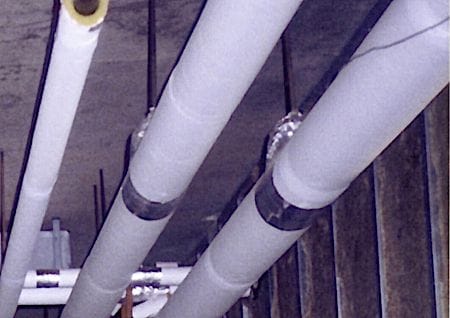
Moulded sleeves made of polyethylene and neoprene foam are available in various thicknesses and sizes to fit all pipes. The sleeves are slit on one side so that they can be easily placed on the water pipe. Foam insulates more effectively than fibreglass or glass wool because more air is trapped in the material. In addition, foam breathes better and less condensation water accumulates. Foam can be easily cut to the desired length with a knife and flexibly placed over bent pipe sections and joints that are particularly sensitive to sudden frost.
Neoprene or acrylic adhesive tape can be used to bridge small gaps at corners and seams and pipe sections.
The holes through which a water pipe runs into the wall let cold air through. Silicone putty can be used to effectively seal these holes. Polyurethane foam, which is sprayed into the gaps and then spreads so that all gaps are sealed, is easier to work with. The foam can be used around junction boxes, around doors and windows to make them airtight. After the foam has cured, excess foam can be easily cut away with a carpet knife pressed flat against the wall.