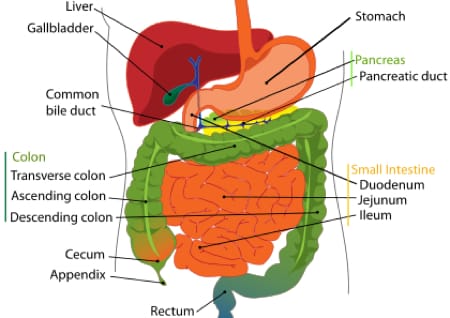
The digestive process is more lengthy than one might think. When food is taken in through the mouth, it takes several hours for it to work its way through the different parts of the digestive system. In fact, digestion begins even before you have ingested the food.

Like other processes in the body, digestion is controlled by the brain. Even while you are just about to put food in your mouth, the brain sends a signal to the digestive system to prepare the digestive juices. Chewing in the mouth mixes the crushed food with saliva, which contains digestive enzymes. The saliva also makes it easier to transport through the oesophagus into the stomach by lubricating the food, so to speak.
The food remains in the stomach for at least three to four hours. There, the stomach acid breaks down the food components. The resulting mush is passed on to the intestine, where it remains for another six to seven hours. This is also where the absorption of nutrients takes place. In the excretory intestine, the water is removed from the food. The undigested food remains there until it is excreted. The complete digestion process thus takes 12 to 24 hours, or even several days, until all traces of the food have been removed from the body. It also depends on the type of food. Certain foods are more difficult to digest than others. A steak, for example, will only be fully digested after three to five days. White flour products also remain in the body for a longer time. High-fibre foods, on the other hand, as well as vegetables and fruit, are easy to digest. Foods with a high sugar content, industrially processed food and alcohol hinder the digestion process.
By observing the duration of the individual's digestive process, one can check one's state of health. Too' fast elimination means that important nutrients are not absorbed and are simply lost. If digestion takes too long, intestinal diseases can develop.