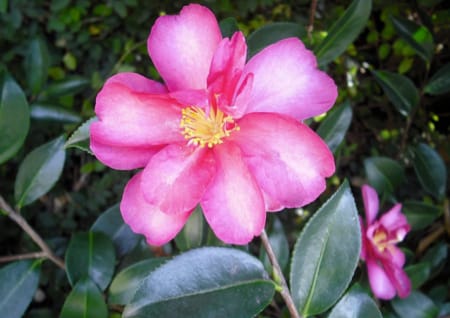
The camellia shrub is relatively hardy and not difficult to care for. With their soft colours, camellia flowers are a beautiful eye-catcher in the garden, even out of season. The most important aspect of caring for a camellia is the amount of sunlight the plant receives. The ideal location is one that protects the plant from early morning sun and late afternoon sun and offers it a few hours of midday sun.

After the first buds appear in March, the camellia should be fertilised. The plant should be fertilised twice more between March and August. The fertiliser used should be specific to the needs of the camellia and dosed according to instructions. The fertiliser is spread in the soil around the widest part of the plant and poured into the soil with water.
The soil of the camellia should always be kept moist to a depth of around 30cm. The camellia does not like muddy soil, but needs permanent moisture. Until you find the right amount of water required to keep the soil moist at a depth of 30cm, you can dig a small hole of the appropriate depth about 15cm from the root and measure how much water is needed. A camellia that is permanently in muddy soil will die and should therefore be raised with good drainage.
The ground around the shrub should be covered with a 10cm thick layer of mulch.
Check the camellia regularly for aphids and spider mites, which are the most common parasites of the camellia. The parasites can be treated with sprays.
Before the camellia bush sprouts again in early spring, it should be pruned. Cut back all dead and weak branches completely. An overgrown camellia bush can be pruned to half its size, which will not damage the plant but will probably prevent it from flowering in the coming season.
Camellias prefer soil that is slightly acidic with a pH value between 5.5 and 6.5.
The camellia is also known as the green tea plant.