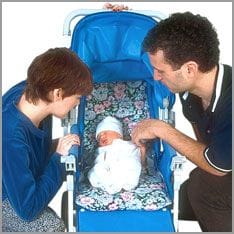
 Before the birth and at the beginning of life with the first child, the parents' feelings are usually positive throughout, and they await the arrival of the new family member with excitement and curiosity.
Thoughts that go in a negative direction are normally quickly replaced by positive thinking. Postnatal depression can occur, but is usually a temporary phenomenon and not a cause for excessive concern for the majority of mothers.

Everything is geared towards the baby's well-being, you endeavour to do everything right and sort the tips and advice offered from all sides according to usefulness and applicability, because they are not all useful after all.
However, while you are busy being a good parent, situations can gradually arise that can upset your emotional world.
The older the child gets, the more independent it becomes and the better it can express its own wishes and preferences. These wishes and preferences do not automatically coincide with those that we as parents have in mind. Our own wishes must therefore often first be adapted to those of the children, otherwise we run the risk of trying to manipulate them at a very early age and force them to adapt to us parents.
This view was held in earlier styles of education, but cannot be upheld in the light of today's knowledge of children's mental and physical development.
If we want to raise our children to become independent personalities with both feet firmly on the ground, we cannot forbid them to develop freely as babies and toddlers.
Things can and will happen that you didn't expect and that cause you worries and problems with your own feelings:
The son or daughter is much more fixated on their partnerthan on yourself and seems to favour you. This can lead to feelings of jealousy, which would have a negative impact on the whole family. In most cases, however, this jealousy is unfounded, as the baby may react more strongly to the parent who is able to spend less time with them.
Being closer to one parent will also inevitably mean that the child will test its limits more on that parent than on the parent who has little time for the child, because the main carer is also the one who imposes rules and restrictions on the child that it wants to rebel against.
The baby or toddler does not want to eat: This can very easily lead to people taking the behaviour personally and thinking that the child is doing this on purpose to express disapproval, especially if you cook with a lot of love and effort yourself. Here too, the causes usually lie elsewhere, such as the timing of the meal. Consistency or new preparation methods should also be tried again and again.
The child clings too tightly: In this case, a feeling of being overwhelmed can easily arise. The child has not yet learnt that the parents are there for them, even when they are not present, and must be slowly accustomed to this by leaving them alone with other carers. Parents should not worry too much if the child cries, as this will normally resolve itself after a short time.
You will be doing your child a much bigger favour if you help them to get along without you rather than trying to be available to them at all times and at every moment. This is impossible in the long term and not very beneficial for the child's development.
The child's defiant phase is particularly strong: A parent can quickly feel rejected and unloved if they have to constantly fight with a petulant child. It is important to remember that this phase is normal, but that it is usually only escalated by the child's own behaviour. This is particularly common when parents are unable to keep calm and begin to engage in power struggles with their children, scolding and shouting a lot.
Here it is important to introduce a few, but valid rules and to master the rest of the situations with more tolerance and understanding, but above all to keep calm. Otherwise you teach the children exactly the behaviour that you actually want to avoid and become increasingly unhappy and unbalanced yourself, because such situations are extremely stressful as they cost a lot of strength and energy.