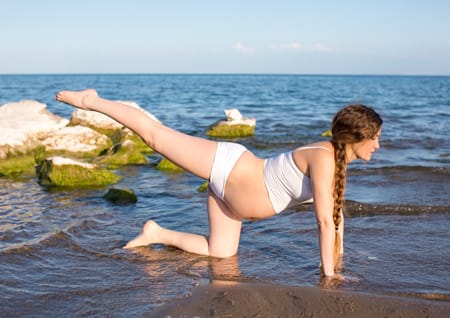
Even or especially during pregnancy, it is important to stay physically fit, but in a way that does not endanger the unborn baby. The best way to keep the heart and body fit during pregnancy and thus prepare for the birth process is through regular gymnastics.

Pregnancy already affects the physical fitness of even well-trained women in the first trimester. However, this is temporary; the body goes through strong changes, which affects sporting activities and also everyday activities. It is important to pay attention to the body's signs and take a break immediately if you feel tired.
Regular gymnastics during pregnancy often requires more motivation than usual, but it pays off because typical accompanying symptoms such as hip and back pain and constipation, the risk of gestational diabetes and depression are reduced. In fit women, the birth process is usually accelerated. Not to mention that you get your old figure back faster after pregnancy.
Gymnastics with fast, jerky movements are not suitable for pregnant women. This includes step and aerobics.
Which gymnastics are good for pregnant women?
Pilates
Pilates trains the abdominal muscles. Strong abdominal muscles support the growing belly and reduce back pain. Also, with well-trained abdominal muscles, you are better able to push the baby out during birth.
However, from the third trimester onwards, exercises that involve lying on your back for long periods of time should be avoided. Alternatively, you can use special back pillows that ensure that your head is higher than your belly. You can still do exercises in the side position, stretching exercises and upper body work.
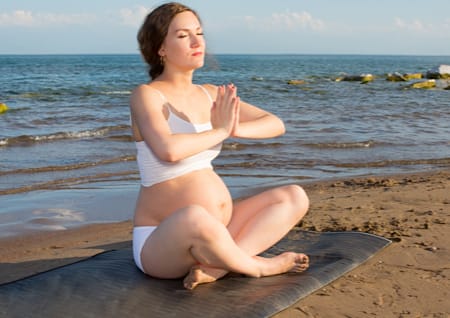
Yoga
Yoga strengthens the core and improves flexibility through gentle movement, breathing and meditation. It also has a calming effect, which is very positive for pregnant women. After the 20th week, one should avoid extreme body twists as well as exercises in prolonged prone and supine positions. Headstand is of course prohibited.
Water gymnastics
The good thing about water aerobics is that the water supports the weight of the body, you cannot fall, you cannot make jerky movements and you are automatically cooled down. This is why water aerobics is especially popular in the last trimester of pregnancy. For safety, you can wear water shoes to avoid slipping on the bottom of the pool.
Cardio exercises
The rule of thumb for exercise during pregnancy that increases heart rate is: if you were active before pregnancy, you should stay active; if you were not active, you should not start during pregnancy. The safest cardio exercise for pregnant women is a daily half-hour walk.
Even women who are active in sports should cut back during pregnancy and work at about half the intensity.
As blood volume and heart rate increase during pregnancy, the readings on the cardio machine in the gym are not accurate and should be disregarded. Cardio machines such as the treadmill and stationary bike are well suited.
Both are ideal because you can control the level of difficulty. With the running bike, it is basically better not to jog but to walk.
Strength training
A pregnant woman should stay away from any equipment that squeezes or strains the abdomen or lifts weight above the head. From the second half of pregnancy onwards, strength exercises in the supine position should also be avoided.
Free weight training can be continued if the woman is already used to it. Those who are not used to it should not start now, because the joints are looser during pregnancy and you tend to overstretch.
In principle, these exercises are allowed:
Lower and mid-back: Lat pulldowns and Cable Row in a seated position. As the abdomen and breasts swell, the shoulders begin to lean forward. By strengthening the muscles between the shoulder blades, a hunched posture is avoided.
Chest: Chest press in sitting position.
Arms and shoulders: Biceps and triceps exercises (arm curls)
Lower body: Leg bends and leg stretches while sitting.
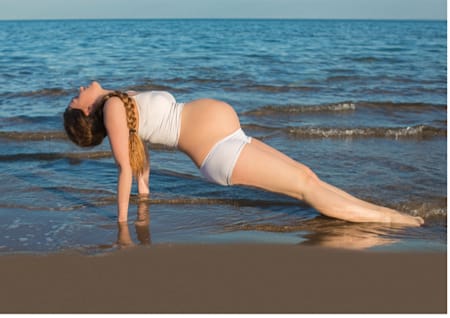
Centre of the body: Plank. Get into bench pose and place the wrists directly under the shoulders. Lift the knees off the floor without hyperextending the back so that the whole body is straight. Hold for two breaths, then release.
Lateral raises and squats.
Important: Take a break or stop as soon as it feels uncomfortable. Under no circumstances should a pregnant woman overexert herself during gymnastics.