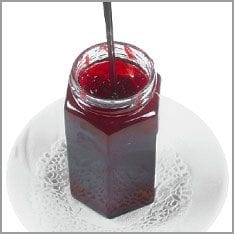
Jam consists primarily of fruit and sugar, which is boiled down to gel on the one hand and to preserve it on the other. It is not difficult to make your own jam at home, but it does involve a bit of work.
Firstly, select the fruit to be preserved and prepare the utensils.
You either need preserving jars, which you can buy in shops with a rubber sealing ring, or you can collect old jam jars or other jars with a tight-fitting lid. There is also special transparent film to seal the jars, also available in shops.

It is particularly important that the preserving jars, of whatever type, are cleaned well and sterilised in boiling water for approx. 10 minutes before use. The shelf life of the jam depends on this, among other things. You can put the preserving jars in the oven for a few minutes to dry them; this is better than drying them with cloths, as these can contaminate the jars again.
You also need a large pot and a stirring spoon, and finally a ladle to pour the jam into the jars. These utensils should also be cleaned very thoroughly.
When choosing the fruit, you should make sure that it is ripe and not infested with mould, as the mould continues to live even after preserving. You can combine several types of fruit or preserve only one type of fruit.
The only absolutely necessary additive is sugar, but there are many recipes in which alcohol, honey or flavourings such as vanilla or cinnamon are also added to create special flavours.
The sugar can be added in different proportions, which affects the flavour and shelf life of the jam. The longest shelf life and sweetness is achieved by mixing 1:1, i.e. boiling down one part fruit and one part sugar. However, mixing ratios of 2:1 and 3:1 are also possible; the less sugar, the more sour and less long-lasting the jam will be. Once opened, it is best kept in the fridge.
It is recommended to use gelling sugar to ensure the jam has a good consistency. Gelling sugar contains added pectin, the substance contained in the fruit that is responsible for gelling. Gelling sugar also contains citric or tartaric acid, which in turn ensures that the jam keeps well.
Although you can also use normal household sugar, the jam will then take a long time to thicken with constant stirring and will not keep as long as with the addition of gelling sugar.
You can boil the fruit unpeeled, as the peel helps with thickening and gives more colour, but you should then make sure that the fruit is unsprayed so that the toxins adhering to the peel are not boiled in.
Once you have washed all the fruit and cut it into smaller pieces if it is large, or chopped up the berries a little with a potato masher, you can now put them on the hob. For very dry fruit with little juice, you can add a cup of water.
The jam should now boil for approx. 3 minutes. The protein contained in the fruit can create foam, which is best skimmed off. It can also be eaten, but is not as suitable for filling into jars.
Flavourings such as cinnamon and honey should only be added after the actual cooking, i.e. just before the jam is filled into the jars.
Once the jam has been filled into the jars, place them in a sheltered place to cool completely before storing them.
Enjoy your meal!