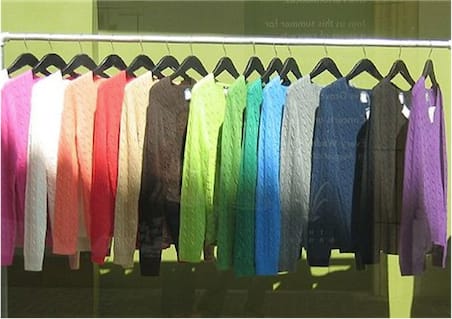
By contrasting the colours and colour intensity of the clothes, you can set accents that emphasise the skin colour, hair colour or a particularly beautiful piece of clothing, depending on your preference. However, you have to do it right for the combination to work. Here are some tips for you on how to accentuate your clothes with contrasts.

Contrasts are achieved by using strong, uniform colours, contrasting colours or different shades of colour. One way of using contrasts to create accents is to use the colour of the face as a base. The colour difference between skin and hair colour is referred to as skin contrast. White skin with black hair provides the greatest contrast, while light skin and light blonde hair provide the least contrast. Clothing that contrasts with skin and hair colour works best. Highly contrasting clothing works best with strongly contrasting skin tones. If you wear clothes with low contrast instead, the eye is drawn to the face. Generally speaking, dark-coloured clothing has more contrast and lighter-coloured clothing has less contrast.
Complementary colours are colours that are exactly opposite each other on the colour wheel. The complementary colour to blue, for example, is orange. Complementary colours are not similar to each other and do not necessarily suit every skin type or eye colour. They are used to complement and emphasise each other. You should experiment a little with complementary colours until you have achieved the desired effect of the colour combination. It is usually better to wear one colour with a paler version of its complementary colour.
Related colours can also be found on the colour wheel. These colours are not opposite each other, but lie directly next to each other. They have similar shades and are therefore pleasing to the eye. Within these related colours, you can choose more or less intense colour intensities. When choosing these colours, it is important that they match the skin type. Typical examples of related colour combinations are yellow with yellow-orange, red and pink or blue and turquoise.
To combine clothes skilfully, you should not wear more than two colours at the same time. If you wear several items of clothing, they should either be exactly the same colour, related or contrasting, but not almost the same.
In addition, neutral colours such as brown and peach should not be combined with warm tones such as pink or purple.