The so-called Müller-Lyer illusion is an optical illusion consisting of a stylised arrow. If you look for the centre of the arrow line, you usually place it more towards the rear end. This optical illusion was developed by L.C. Müller-Lyer in 1889.

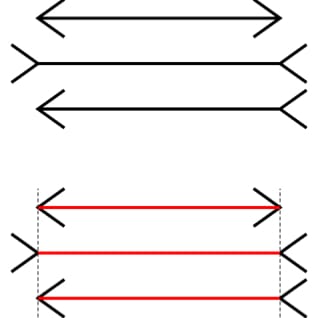
The more common variant of this illusion today consists of several arrows. The straight lines are topped with points that point inwards in the form of an arrowhead, while the rear end of the arrow has two lines pointing outwards. Another figure consists of two ends pointing inwards and the third figure consists of two ends pointing outwards.
The illusion is that the figure with the two ends pointing outwards is perceived as the longest and the one with the two ends pointing inwards as the shortest, even though all three lines are exactly the same length.
One possible explanation is that the brain calculates the depth and distance of objects based on the angular configuration. In other words, an object with inward-pointing angles is interpreted as closer and one with outward-pointing angles as further away.