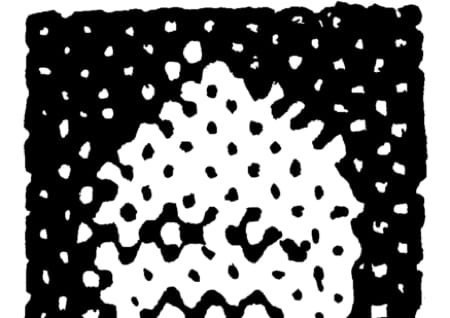
Halftone illusion is a reprographic technique that simulates continuous colour tones using dots of different sizes with different distances between them.

The halftone process reduces the visual reproduction to a binary image printed in a single colour. The binary reproduction works through an optical illusion in which the tiny halftones blur into one another through the human eye.
Black and white photographs also consist of only two colour tones when viewed under a microscope. The different shading of the individual dots creates the effect of a series of different colourations.
The illusion of the human eye using the half-tone technique was developed by William Fox Talbot in the 1850s.