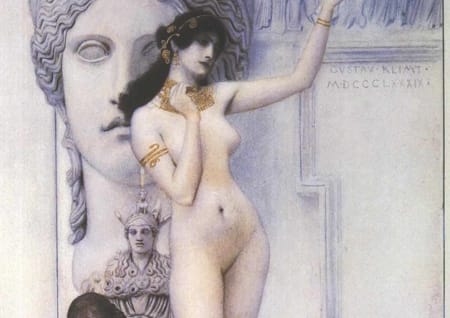
Art Nouveau fought against disdain for decades, but is now recognised as an independent style. A distinction is made between two styles: floral Art Nouveau and geometric Art Nouveau.

Art Nouveau had its heyday in the short period between 1894 and 1914 and favoured ornamentation and surface decoration. The idea behind Art Nouveau was to add beauty and style to everyday life. The style is characterised by elegantly sweeping outlines, sumptuously ornamented surfaces and sculptural, floral or organic decorations.
The style became internationally popular and was given different names in other countries. In Germany, the term Art Nouveau was coined after the then modern Munich magazine "Jugend". In Austria, the term Secession style was used, in France Art Noveau, in England and the USA Modern Style and in Italy Stile florale or Stile Liberty.
The main representatives of Art Nouveau in Germany were Peter Behrens, Richard Riemerschmid, Fritz Endell, Bruno Paul, Hermann Obrist and Bernhard Pankok. In Vienna, it was the architects Otto Wagner, Josef Hoffmann and Josef Maria Olbrich as well as the Austrian painter Gustav Klimt.
In France, the architect Héctor Guimard produced many Art Noveau works, as did the painter Henri de Toulouse-Latrec. Other notable artists of the New Style were William Morris (England), Charles Rennie Mackintosh (Scotland), Victor Horta (Belgium) and Louis H. Sullivan (USA). A master builder with a special style of this era was the Catalan Antonio Gaudi.
How do you recognise Art Nouveau architecture?
How do you recognise Art Nouveau paintings?