 In our western Christmas tradition, the figure of Father Christmas appears everywhere and in many different ways, but who was Father Christmas actually?
Christmas celebrates the birth of Jesus Christ, which took place more than 2000 years ago in Bethlehem. The Feast of the Magi, which is celebrated on 6 January, has helped to shape the tradition of gift-giving, as the wise men came to Bethlehem to honour the Christ child with presents.

However, there was no mention of Father Christmas at that time, neither in connection with presents nor with the birth of Jesus Christ, as he only lived a few centuries later.
St Nicholas, known as Santa Claus in English, is a historical figure who lived in the fourth century AD. St Nicholas was the Bishop of Myra, which is located in modern-day Turkey. This Nicholas of Myra gained great popularity with his merciful deeds, as he was considered a benefactor especially of children and was canonised by the Christian church for his good deeds.
Apart from the children, many other groups appointed him as their patron saint, among them the merchants and sailors.
One story of St Nicholas tells of how he gave gold to three daughters of a poor man. The man was about to sell his daughters as he could not find husbands for them. In those days, it was customary for women to bring a dowry into marriage, but the man was too poor and could not afford a dowry. St Nicholas brought the gifts secretly over two nights, and when he came a third time to give the last daughter a present, the father discovered him and was able to thank him.
This is how the story became known, which later led to the custom of children hoping for a gift on the morning of 6 December, St Nicholas' birthday. To do this, they put their shoes outside the door the evening before so that he can fill them with something.
This custom revolves around the birthday of St Nicholas, which is considered a church holiday in many Christian traditions. The fact that Father Christmas, or St Nicholas, brings presents at Christmas is due to the fact that originally St Nicholas' Day was also the day for giving presents, and in some cultures this has been preserved. In others, however, this was later shifted to the birthday of Jesus Christ as interest in the veneration of saints declined during the Reformation of the Church.
That's why in some areas the idea that Father Christmas brings the presents prevails, in others that the Three Wise Men do.
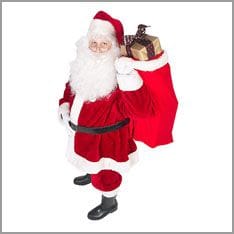
Santa's clothing, a red coat with white decorations, can be traced back to the clothing worn by Catholic bishops.
Over the centuries, a wide variety of customs have developed from legends and stories about the figure of St Nicholas of Myra, which can vary greatly from region to region and sometimes incorporate other customs.
Popular customs have emerged that are being adapted and adopted by more and more cultures and have long since become relatively independent of religion. For example, Father Christmas is known to travel through the night sky on a sleigh with reindeer and distribute presents by throwing them down chimneys or climbing down the chimney himself.
A historical figure has thus become a mythical legend whose origins are becoming less and less significant, but at the same time promotes cohesion among today's cultures.