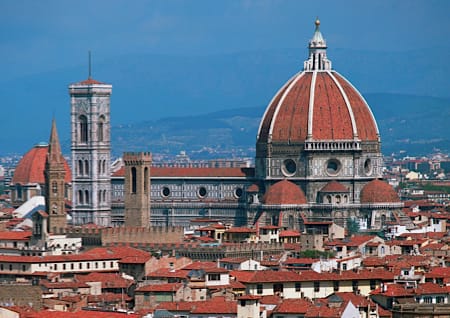
At the centre of the Renaissance was the revolutionary decision of architect Filippo Brunelleschi (1377-1446) to apply the forms of classical architecture, especially Roman architecture, to his buildings. The buildings were based on the orders that the Romans had adopted from the Greeks. Each of these orders had building elements with fixed dimensions and forms (Doric, Ionic and Corinthian). The dimensions of the entire building were determined by the respective order. Since the main focus of architecture was on design and less on construction, Renaissance buildings consisted of two components: the masonry inner structure and the outer decorative façade. The building structure was designed solely for its practicality and contained simple geometric shapes such as the cube and parallelepiped. The relationship between height, width and depth was to be evident and its representative effect obvious. The barrel vault was favoured as the roof construction instead of the cross vault. Occasionally, vaults were dispensed with altogether and wooden flat ceilings were built.
Renaissance columns consisted of a base, shaft and capital, on which the entablature lay, which in turn was divided into architrave, frieze and cornice.

While churches were mainly built in the Middle Ages to express the architectural style, the Renaissance focussed on palaces for wealthy merchants. For both palaces and churches, the focus was on an impressive façade and defining the functional purpose of the building. In palace architecture, four blocks were laid out symmetrically around a central courtyard and connected by arcades.
Later, the Renaissance found its way into urban planning. The market square became the architectural centre. Outside of Italy, Renaissance elements were mainly used in the decorative area. The structure was built according to classical traditions and richly decorated with modern stylistic elements, especially the portals, gables and window frames.
For a long time, the main centre of the Renaissance was Florence, while in northern Italy most buildings were still in the Gothic style. Eventually, the Renaissance spread to France, Germany, England and Spain. Towards the middle of the 16th century, the style in Italy tended towards Mannerism under High Renaissance artists such as Michelangelo. Classical rigour was replaced by ingeniously exaggerated art.
The classical form of the Renaissance consisted of a few, deliberately arranged decorative forms. The building was to be clearly structured and not marred by too much decoration. The individual storeys were grouped together and clearly separated from each other by arcades and columns. Each zone had certain basic motifs that were repeated in order to create a uniform image. The edges between the storeys were accentuated by decorations.