After Jaques E. Brandenberger observed a restaurant guest spilling red wine on a tablecloth in 1900, he decided to make the tablecloths waterproof by applying a thin film and began experimenting.

Unfortunately, his initial experiments were not particularly successful, as the tablecloth ended up being stiff rather than water-repellent.
Already discouraged, Brandenberger realised during his last attempt that the protective film could be removed from the tablecloth. He recognised this film as an extremely useful by-product of his experiments and began developing a machine for the mass production of this protective film, which we know today as cellophane.
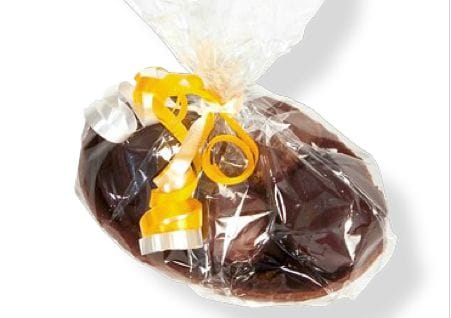
Today, cellophane is mainly used for food packaging, but also forms the basis for self-adhesive films.