By now, some Germans have heard the word piñata and know what it means, but there are probably still many who have no idea what it means.
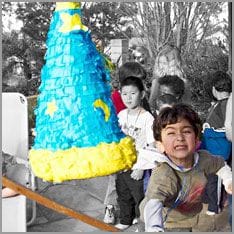
The piñata is a container that is filled with sweets and surprises and then hung on a rope above the children's heads, who have to try to hit it with a stick until the piñata breaks.
Traditionally, the container is made of clay, but today more child-friendly materials such as cardboard or papier-mâché are often used. The contents have also changed somewhat; instead of the traditional nuts and dried fruit, there are now often more modern surprises, such as sweets, small toys, confetti, garlands and trumpets.

In Latin American countries, Mexico and Spain, this custom is a must for children's birthdays.
The origins of the piñata probably developed from the traditions of various peoples, as research has found evidence of its origins in China, among the Europeans through Marco Polo, among the Aztecs, Maya and in Mexico, sometimes used at Christmas time, at carnival time or also for missionising Indians.
The shape of the piñata today can also be very different, you can find cows, donkeys, stars with seven points, or simply round containers, there are no limits to the imagination.
To make a piñata yourself, you should make a papier-mâché mixture from newspaper and paste, which you then apply to a balloon to give it a round shape. This is the simplest version.
Once the piñata has dried, which takes around 1-2 days, you can decorate it further by colouring it, sticking things on it and making your chosen character. A hole is cut in the top so that the surprises can be filled in. Now the piñata is hung up so that it floats and dangles above the heads. Each child can take it in turns to try to hit the piñata with a stick and blindfolded until it eventually lets its contents rain down on the floor.
Now all the children can collect the contents as quickly as possible. Instead of just one piñata, you can of course prepare several so that everyone can have a go.
With older children, in addition to the blindfold, you can make the game even more difficult by moving the piñata back and forth so that more blows go astray.
For very young children, there is also another version of the piñata where, instead of hitting it with a stick, you have to pull on strings hanging from the bottom to pull it open so that the contents fall out. Several threads can be attached to fool the child so that only one child will actually catch the right thread.