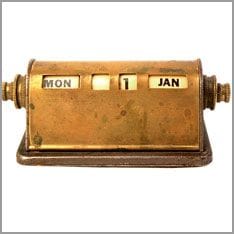
We take it for granted that we live according to a calendar, and our Gregorian calendar is now known even in areas where a different calendar actually divides the year. The Chinese, Jews, Islam and various primitive peoples have always had their own calendars, even if they have often adopted our calendar, the Gregorian calendar, for the sake of simplicity.
The most obvious source of orientation for measuring time has always been the sun, moon and stars. In times when they alone were used to calculate time, other calendar systems were developed that corresponded to the logic of observing these celestial bodies.

For thousands of years, long before the birth of Christ, there were calendars based on the moon and its phases. The moon completes its cycle of orbiting the earth in 28 days and is easy to observe, as it is sometimes full and sometimes waning in the sky.
This is how the months were determined, which is also how the word month got its name. The length of the year itself was based on the sum of the months, which in turn depended on the seasons. So early on there was a year with 12 months, but only some time later a year with 365 days.
The ancient Romans were the ones who developed the calendar systems relevant to us, from which our current form was derived after several changes.
The ancient Roman calendar initially only had 10 months, but as this method of counting soon revealed errors, Julius Caesar soon introduced the 12-month calendar.
But even this so-called Julian calendar proved to be not entirely reliable and had to be changed by introducing leap days.
There was confusion among subsequent rulers as to how to organise the still imprecise calendar in a satisfactory and reliable way. The time shifts became more and more apparent, as religious festivals suddenly shifted with them.
Nevertheless, it took until the end of the 16th century to implement a reform, which came about under the reign of Pope Gregory. Around 1582-1585, the reform was implemented in the majority of Catholic countries and the year was shortened by several leap days. In other countries in Europe and the world, the adoption of the Gregorian calendar took much longer, or was only implemented when modern trade relations made it necessary.