Wet nurses' tales are particularly common around pregnancy. Actually, the term comes from the time when wet nurses looked after the children, which was usually the case if the family was noble, or at least belonged to the better class and had domestic servants.
So it is said that the term coined itself in the 18th century, around the stories that wet nurses told their entrusted charges. It is said that they did not exactly prefer the gentle method, but chose gruesome stories to scare the children to bed.
The tradition of bringing up children with discipline and order still prevailed, so they found a way to keep the children under strict control.

Old wives' tales include above all traditional folk wisdom that is based on facts that cannot be proven.
These always have to do either with superstition, or with exaggerated wishful thinking, for they usually describe ways and means of influencing fate, or at least finding out ahead of time what is intended in it.
So nowadays there are particularly many old wives' tales around the subject of pregnancy, here the old wives' tales fall on particularly fertile ground, because all parents-to-be are interested in whether they are having a boy or a girl.
Moreover, in earlier times, the dangers that led to pregnancy loss could not be assessed in the same way as today. For example, an old wives' tale says that one must not stretch, lest the umbilical cord break.
If you want to know the sex before birth, look for certain signs, for example, if you hardly feel any nausea during pregnancy or have cold feet all the time, this means it will be a boy.
If you blossom during pregnancy, it will also be a boy, if you look rather dull and weary, it will be a girl.
Another old wives' tale is that a lot of nausea during pregnancy means that you are rejecting the child.
A myriad of old wives' tales can be found, all of which seem more or less credible if you want to believe in them.
Many people are convinced that there is always a grain of truth in such wisdom, because often the old wives' tales are actually true. However, this is hardly true if they could be disproved by science, yet many old wives' tales still persist.
Perhaps the whole thing has more to do with the fact that people find such a way to interfere in the things and affairs of others. After all, it's incredibly interesting to test daring assumptions for accuracy. You get something like carte blanche to be indiscreet. So the dynamics of old wives' tales are also likely to satisfy a kind of sensationalism.
The mother or mother-in-law is suddenly allowed to make comments like "I hope you didn't drink alcohol at conception, otherwise the child will be an alcoholic" without having to be accused of bad intentions.
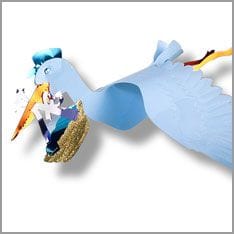
Anyone who sees a stork in the field should strictly check that they have not forgotten to take the pill if they do not wish to have children at the moment, because storks are known to bring the children.
If one finds even the slightest similarities, this gives reason for narratives and generalisations and the confirmation of old wives' tales.
Even though one should not believe in old wives' tales at all, usually dismissing them as humbug, one should not underestimate their power, for, as I have said, the more one pursues the desire to which they refer, the more they bear fruit.
So it can happen that superstition wins out after all and you try to change your behaviour, just in case there is something to it.
Finally, there are old wives' tales that have come true in some form or another, such as cats stealing little babies' breath. There have been cases where cats have sat on the baby's face because it was cosy and warm there, causing them to suffocate.
Whether one should therefore take all old wives' tales seriously remains very doubtful.