Amblyopia is a visual impairment in one or both eyes. In obvious cases, this visual impairment is characterised by strabismus.

Usually, the affected eye is structurally perfectly healthy, but the squint sends blurred images to the brain. The brain learns to interpret these blurred images as normal, so that even with glasses, no sharp image is produced.
Amblyopia can only occur in children. If this visual impairment is not treated, it can lead to permanent vision loss.
There are different types of amblyopia; a distinction is made between strambismic amblyopia, deprivation amblyopia and refractive amblyopia, whereby the result in all forms is a deterioration in the vision of the affected eye.
Strabismus amblyopia develops due to strabismus, i.e. when the eyes are not straight. An eye can turn inwards, outwards, upwards or downwards. The images sent by the twisted eye are "switched off" in the brain and vision is reduced.
Deprivation amblyopia develops, among other things, due to lens opacity and can affect both eyes. If this form of visual impairment is not treated at an early stage, permanent visual damage remains.
In refractive amblyopia, one eye has very different vision to the other eye. The eye with more farsightedness is usually "switched off" by the brain. As the eyes are usually straight anyway, this problem is often only discovered after an eye test.
Although surgery is possible to straighten misaligned eyes, it usually does not cure the visual impairment completely or at all. Eye surgery is only beneficial if it allows the eyes to work better together.
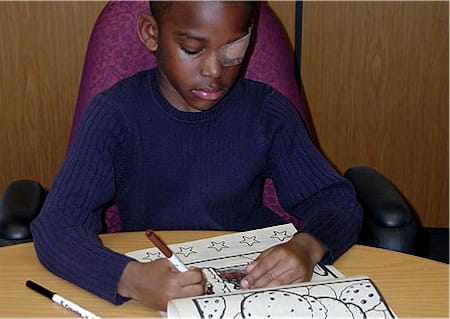
Surgery is sometimes necessary for children with congenital clouding of the lens. After the operation, the child must wear glasses and an eye patch.
The ophthalmologist recommends either treatment with eye drops or a permanent Eye patch.
In rare cases, the treatment is not one hundred per cent successful. Cancelling such a lengthy treatment is not an easy decision, but can sometimes be better for the child and the parents. The good eye needs to be protected, but as long as it remains healthy, children can cope with almost all aspects of life.