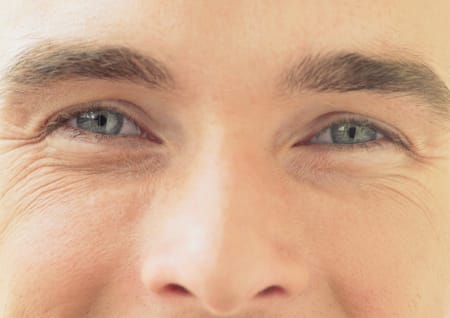
Whether people with a light eye colour are actually more sensitive to light has not been fully proven. The darker the eye colour, the more pigments there are in the iris, which provide a more effective shadow the smaller the pupil becomes due to the incidence of light. On the other hand, light sensitivity is also controlled by the retina.

The light receptors of the retina enable vision by converting photons of light into nerve impulses that are transported to the brain via the optic nerve. Numerous chemical reactions take place in the photoreceptor cells, which react to different light conditions. In the human eye, black and white information is transmitted by the rods, while different colours are perceived by the cones. All these separate detectors together form the overall picture that we perceive. In bright sunlight, only the cones work, while in the dark only the rods transmit enough information.
Some people are more sensitive to light than others. In extreme cases, photophobia can also develop, where bright light sources such as sunlight or neon lights cause discomfort. To compensate for the hypersensitivity, you have to squint hard or close your eyes. Occasionally, photosensitivity also occurs together with headaches.
Hypersensitivity to light can have various causes, although photophobia is not a disease but merely a symptom. Typical causes are migraines, eye inflammation or viral diseases. People with light-coloured eyes often seem to react more sensitively to bright light. However, it has not been proven whether eye colour is the reason for the sensitivity. It is also possible that a person with light-coloured eyes suffers from other medical conditions.
Other causes of photophobia
Corneal injuries
Moon blindness (uveitis)
Meningitis
Retinal detachment
Eye irritation due to contact lenses
Sunburn
refractive surgery
Sausage poisoning (botulism)
Rabies
Mercury poisoning
Conjunctivitis
Corneal inflammation (keratitis)
Iritis (inflammation of the iris)
Various medications can cause photosensitivity as a side effect. In very rare cases, there is an underlying genetic disorder.
What can be done against light hypersensitivity
The most effective treatment for photophobia is to eliminate the disease that triggers it. Once the disease is cured, the sensitivity to light usually disappears by itself. People who are naturally sensitive to bright light should avoid bright sunlight and bright light sources or wear sunglasses and a wide-brimmed hat. In extreme cases, special contact lenses can be worn to control the incidence of light.