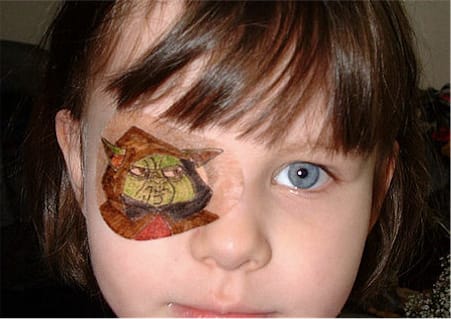
A relatively widespread problem in children is amblyopia, a visual impairment that is commonly referred to as "squinting". Amblyopia is one of the most common causes of reduced vision.

The "bad" eye sends blurred images to the brain. Although glasses give the child stronger vision, they do not completely correct the problem. Due to the visual impairment, the brain has learnt to see blurred images and is unable to interpret the sharp image from the glasses. For this reason, a plaster is applied to one of the child's eyes, which completely prevents images from being sent from this eye to the brain. The uncovered eye is "forced" to see correctly and becomes stronger.
The treatment of Amblyopia with a patch should only be used if prescribed by an ophthalmologist. The doctor should regularly check how the eye patch is affecting vision. Early treatment at a young age is quite successful. It is important to follow the ophthalmologist's instructions exactly. The dominant eye is taped to train the weaker eye.
The plaster is applied directly to the eye or to a spectacle lens. An eye patch is not suitable as children can easily push it up to see with their eyes.
An alternative to eye plasters is treatment with eye drops. The vision of the dominant eye is temporarily weakened with drops to strengthen the weak eye. Eye drops are used for mild cases of amblyopia or if the child is unable to wear a patch. Both forms of treatment achieve equally good results in mild forms of visual impairment, but the ophthalmologist decides which method is appropriate for the child.
If the dominant eye is short-sighted, eye drops are not recommended as a treatment.
Although the eye patch improves vision within a few weeks, it usually remains on the eye for several months for optimum results. Once vision has improved and the patch is removed, it is often necessary to apply a new patch for several hours a day or to use eye drops as a follow-up treatment. This follow-up treatment may be necessary for several years.