Children learn best in practical experiments. Here are a few simple experiments to do at home on the subject of air pressure.

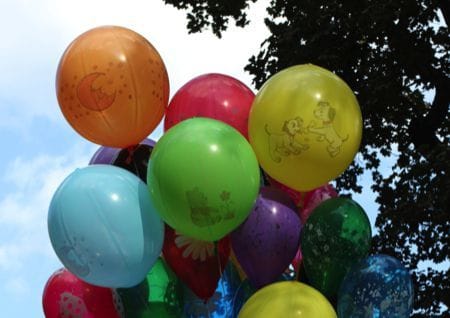
Blow up a balloon. When it is nice and plump, don't tie a knot in it, but let it fly. The air pressure inside the balloon is much higher than outside, so the air escapes as fast as it can through the small hole in the balloon. The speed at which the air strives to equalise pressure causes the balloon to shoot forward until there is no air left. From this you can make your own balloon rocket. Blow the balloon up and keep the end closed. While you are holding the balloon, a friend can attach a straw to the balloon with tape. Pull a thin string through the straw, stretch it tight and tie both ends somewhere good. When the string is nice and tight, let go of the balloon and it will shoot away along the string with the help of the straw until all the air is gone.

Air may appear weightless, but it has its own weight and just like all matter with weight, air also exerts pressure on its environment. Fill a cup to the brim with water. When the cup is full to overflowing, you can place a piece of laminated paper on the rim of the cup. It is important that the paper is laminated so that it does not become soggy. Press the paper firmly and evenly onto the cup and turn it upside down very quickly. Now you can let go of the paper and you will notice that it sticks to the cup.
This happens because the air pressure presses the paper against the cup from below. No air can get into the cup and thus the water cannot escape from the cup.
Take an empty plastic bottle and close it tightly so that the air cannot escape. Now take a bucket of water deep enough so that the bottle fits completely inside and is covered with water. You have to hold the bottle firmly under water because air is lighter than water and therefore has less pressure. This will force the bottle upwards with the air from the water pressure, so you have to make an effort to push it downwards against its urge. Now you can loosen the cap of the bottle and watch how fast the air rises from the neck of the bottle.