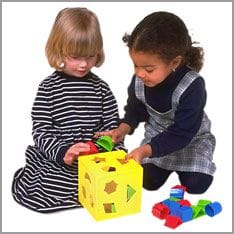
What is certain is that most children have too many toys rather than too few, and this is increasingly the case as children get older.

Nevertheless, it makes sense to provide variety and, due to the rapid growth from one phase to the next, it also makes sense that the toys also adapt and help to stimulate the children's learning process and skills.
Hands off cheap, cheap
Not everything that is cheap is bad, but you should always pay attention to the quality. Babies and toddlers tend to be brutal with toys, and this won't change any time soon, because they don't just play, they also test the laws of physics, e.g. "What happens if I drop this thing off the table?" If toys can break quickly, then the chance of the child injuring themselves also increases.
Plastic that is too thin breaks, poorly sewn soft toys burst open, especially if they are gnawed on extensively, wooden toys wear out quickly and the colour flakes off, or parts come loose that can be swallowed.
Furthermore, cheaply produced toys tend to contain more toxins than those with references to colours and materials that are guaranteed to be "clean".
The louder, the better?
A categorical "no" is appropriate here, because loud toys put a strain on the entire environment. Not only is there a risk that the child's hearing will be affected, but above all the nerves of the people who are exposed to the tooting, whistling, barking or ringing all day long.
I very quickly put an end to a quacking duck by removing its batteries, as it was slowly driving me to the brink of madness to listen to the animal, which also reacted to movements and noises.
Although many toys have buttons to switch them on and off, they immediately lose all their appeal if they are not switched on and in most cases the child will no longer use them for play.
It is better to make sure that the toy has a volume regulator.
A rule of thumb is: what seems loud to you is definitely far too loud for the child!
Are talking toys recommended?
The toy manufacturers will answer "yes, of course", but I personally am not convinced.
At best, talking toys sound like someone talking into a tin can and forgetting to wipe their nose first.
Even though the sound quality has improved considerably compared to earlier toys, most devices still sound robotic and have little to do with the sound of real voices.
Whether this is reasonable is up to you, but for my hearing it is not.
I am also not convinced that this toy fulfils its purpose, namely that it encourages the child to repeat it. Have you ever watched two or three-year-olds playing with a toy like this? They will cheerfully press all the buttons, but in the majority of cases they will remain silent themselves.
Under the guidance of an adult, it may be useful to practise terms in English or another language with the child if you do not speak the language yourself and you want your child to have contact with it at a very early age. However, you should always make the connection to the meaning and not rely on the child understanding it just by using the toy, otherwise the purpose is completely defeated.
For your own language, however, the linguistic example of any native speaker is better than any recording of such a toy.