Originally demonstrated by John Henry Pepper in the 1860s, the illusion is a technique that is still used today in magic tricks with the help of mirror glass and lighting effects. The combination of effects makes objects appear to become visible and invisible or merge with another object.

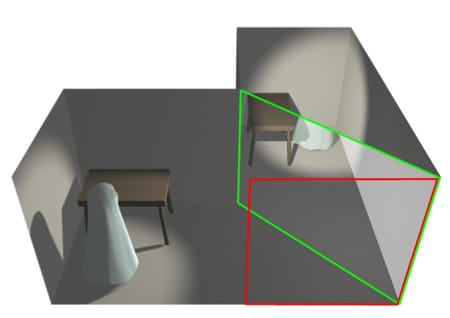
The viewer sees the main room, but does not get a glimpse of the hidden mirror room. The edge of the mirror glass is skilfully hidden in the wall. Both rooms look identical in order to optimise the impression of an object being magicked away. Or the mirror room is painted black, while the objects in it are brightly coloured. As soon as they are illuminated with light, they reflect strongly against the dark background and create a ghostly effect.
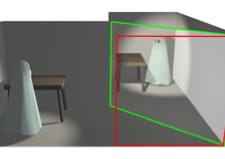
In the illustrations, the viewer sees the main room through the red square. In figure 3, they see a ghost floating next to the table. The illusion is created by a large mirrored glass placed between the spectator and the room. The mirror glass is represented by the green square in the illustration. The glass reflects the hidden space.
Figure 2 shows the scene in which the mirror room is darkened and therefore does not reflect well. The empty main room is illuminated and is therefore very clearly visible to the viewer.
If the hidden room is also illuminated, as in Figure 1 (see above), while the lights in the main room are slightly dimmed, a partially visible ghost appears.
Figure 2
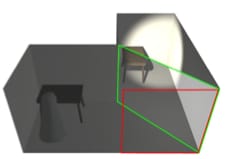
Figure 3