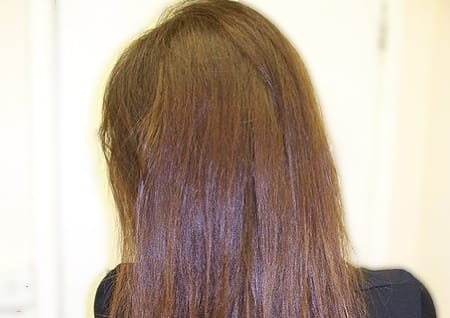
Concern about increased hair loss after childbirth is a major contributor to the normal stress of new motherhood. Many mothers suffer from depression after giving birth, partly because of their appearance. If the hair falls out, the feeling of being unattractive increases.

How do you reduce hair loss after pregnancy?
The cause of hair loss after childbirth
Hair grows in three stages: the anagen or growth phase, the catagen or transition phase and the telogen or resting phase.
Pregnancy hormones keep the hair root in the anagen phase, i.e. the hair grows faster and appears fuller, especially with short hair.
At the end of pregnancy, when the hormones normalise, more hair enters the catagen phase and finally the telogen phase, hence the medical name for hair loss after childbirth: telogen effluvium. Hair in the telogen phase remains on the head for about 100 days before it falls out. This is why hair loss often begins 3 to 4 months after birth and can last up to a year.
As a rule, the volume of hair is reduced to what it was before pregnancy. Many women have become accustomed to their thicker hair and feel bald.
Hair loss is also a common reaction to stressful situations. A particularly complicated birth can therefore lead to increased hair loss.
Reduction of hair loss
As hair loss after pregnancy is controlled by hormones, it cannot be completely prevented. However, hair loss can be controlled with vitamins and diet and new hair growth can be stimulated.
The following tips will help to reduce hair loss and hair regrowth:
Continue to take pregnancy vitamins after the birth. Many women take pregnancy vitamins regularly because of their positive effect on hair, skin and nails. Biotin (vitamin H), silica, calcium and zinc in particular stimulate hair growth and strengthen the hair.
Scalp massages stimulate blood circulation, which in turn stimulates the hair follicles. Scalp massages can be done with the fingers or with a brush, whereby the brush should only be used as a massager after combing through the hair so as not to pull out knotted hair.
The birth should be as relaxed as possible under the given circumstances. Thorough information, a pleasant environment and support during and after the birth will minimise the traumatic experience.
Do not use greasy creams and hair masks, which can clog the pores.
Use mild shampoos. The new hair will initially appear thinner than the rest of the hair as the ends are tapered. When the new hair is cut, you can see that it reaches its normal thickness.