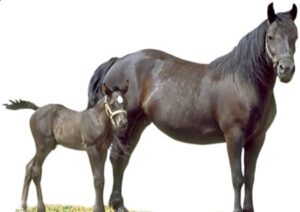
The posture of the tail tells a lot about the character, constitution and mental state of the horse. Depending on the posture, you can tell whether a horse is balanced, active, nervous or tense.

The tail rump is a natural extension of the back and should therefore be loosely integrated into the rhythm of movement. With the change of hind legs, the tail rump moves back and forth. In a tense horse, this rhythm of movement is disturbed. The tail may stick out on one side or be tired.
Crooked tails can be a birth defect, but are more often a sign of back tension. When the horse is cantering, i.e. when the utmost power is developed, the crooked tail posture often disappears.
A tail that is crooked from birth can be straightened surgically. Often the success after cutting the muscle is only temporary and the sloping posture will reappear later.
A tail tucked between the buttocks also indicates inner tension or fear. It can also be a forewarning to wedge out. If the horse pinches its tail while riding, it is obviously not loose enough; the back muscles are not working sufficiently.
In the excited horse, the tail sticks up slightly, just like in the active horse, but is accompanied by nervous tail flicking and prancing.
Frequent tail flicking can be a sign of a girth that is too tight, irritating objects (straws) under the saddle blanket or hypersensitivity to spurs. Mares are particularly known to react to tickling spurs by flicking their tails.