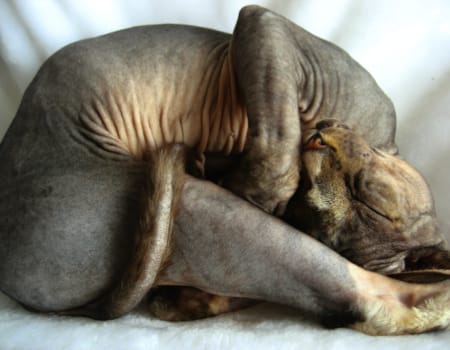
Hairless cats (sphynx cats) are highly bred cats that are often chosen by cat lovers who do not want to have cat hair in their home. However, the fact that a Sphynx cat does not shed hair does not mean that it is easy to care for.

Body fat, which is absorbed by the fur of a normal cat, accumulates on the cat's skin. A bath once a week is therefore advisable.
A cat's coat serves as protection from external influences, so a hairless cat must be protected from environmental influences accordingly. Sphynx cats should not spend too much time in the sun, as they can get sunburnt or suffer other skin damage. Last but not least, skin cancer is a serious risk for hairless cats that like to lie in the sun.
In general, Sphynx cats should not be left outside unsupervised, as their unprotected bodies are less able to regulate their body temperature. In winter, it may be better to put a cat coat on the hairless cat.
Dirt particles, body fat and lard accumulate in skin folds and in the ears, which would normally be absorbed by fur hair. The ears and skin folds should be cleaned when bathing the cat.
Although some hairless cats are known to be hardy species, such as the Canadian Sphynx cat, they are still very susceptible to respiratory diseases, especially as kittens. A kitten should not change owners before the age of 12 weeks, when the kitten is strong enough to cope with the new environment.
A genetic disorder (hypertrophic cardiomyopathy) can occur in sphynx cats.
The digestive system of the Sphynx cat is more sensitive than that of a normal domestic cat. After taking medication, being anaesthetised or eating a diet with less than 80% protein, the Sphynx cat may suffer from diarrhoea, which can last for several weeks. Even a change of residence can upset the Sphynx cat's stomach.
Like any other cat, Sphynx cats should be vaccinated against the usual feline diseases.
Is a hairless cat suitable for allergy sufferers?
A cat hair allergy describes an allergic reaction not to the cat's hair itself, but to the Fel d1 protein it contains. This protein is found in the cat's saliva and in the sebaceous glands. People who are allergic to cats can have an even worse reaction when they come into contact with a hairless cat. However, there have also been studies in which allergy sufferers tolerated hairless cats better than normal cats. This contradiction is explained by the fact that allergy sufferers were more optimistic when dealing with hairless cats, as they believed that only the hair could trigger the allergy. The optimism and positive attitude may have led to adaptation of the body and desensitisation.