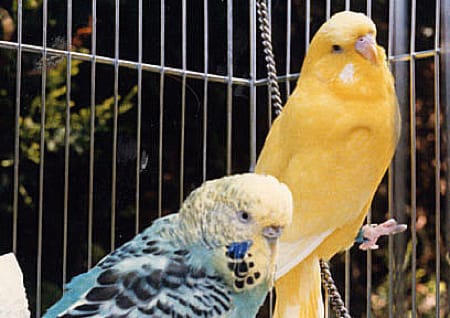
In the wild, budgerigars are dark green in colour. Through breeding, there are now countless different colours among the small parrots.

All budgerigars have a certain basic colour, which mutates through breeding. In the wild, all budgerigars are green. The green ranges from olive to light green with all conceivable colour shades and patterns. The genes of green birds contain yellow pigments. The second most common basic colour in budgerigars is blue, i.e. the genes have white pigments. Breeding forms can produce light blue, pale blue, violet, grey and many other shades.
Various colour factors influence the basic colour and pattern of the budgerigars. Each colour factor reacts differently with the base colour. A dark colour factor brings dark or light highlights to the pattern, while a light colour factor fades the base colour of the bird. A green bird with two genetic dark colour factors usually becomes olive green. A blue bird with a light colour factor becomes light grey or grey-blue. Other colour mutations include grey factor, yellowface, blackface, slate, violet factor, saddleback and clearwing. Each factor influences a different colour scheme or colour pattern on a particular part of the bird's body.
Other colour mutations are lutino and albino. A lutino is a yellow bird with no other colours or patterns and red eyes. An albino is a white bird with no other colours or patterns and red eyes.
Pied budgerigars are birds with patches of different colours or patterns, often called harlequins. There are several genes that influence how much colour or pattern the bird has. These are recessive and dominant genes, which together with other genetic factors can result in fantastic and unusual colour patterns.
Many budgerigars have striped patterns on their wings and head. The three main factors that influence the appearance of the stripes are cinnamon, opaline and fringed (paillette). Cinnamon stripes are brown or black in colour. Opaline creates thicker or thinner stripes. Fringed refers to the thickness of the stripes on the wings and tail.
How do you teach a budgie to talk?
How to recognise that budgies want to breed