If you want to make your aquarium more interesting, you can add a frog or a crayfish or crab. There are a number of different freshwater crayfish, but they require a landing site that is out of the water and are therefore a little more difficult to keep. Most frogs also need land, but there are varieties that can live entirely in water.

Frogs in the aquarium
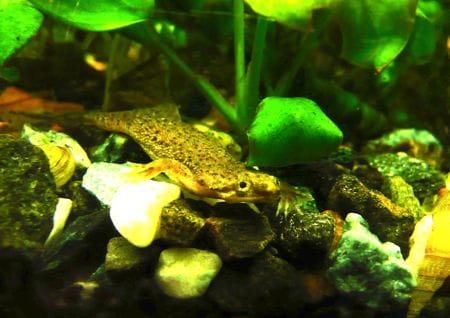
When it comes to frogs for an aquarium, the dwarf clawed frog is recommended, as it can live permanently under water and does not require land above the water surface. As the name suggests, the dwarf clawed frog is very small and should therefore not be placed together with larger fish that regard it as prey. Cichlids, for example, tend to behave aggressively towards an aquarium frog. Loaches and tetras are better suited.
Conversely, a larger clawed frog is itself a predator and is therefore less suitable as company for a tank.
To make the aquarium habitable for the frog, the tank should be equipped with many hiding places. Smooth stones and wood are inviting for the frog. In addition, water plants provide safety for the frog and improve the quality of the water.
The dwarf clawed frog grows to a maximum of 6.5 cm and needs an aquarium with a volume of at least 40 litres. In order to stabilise the water temperature, a heating rod should be available, because the frog needs a water temperature of 22 to 27 degrees. To prevent the frog from jumping out of the tank, the water height should be lowered slightly and the lid for the aquarium should be well and tightly fitted.
Like most animals, the dwarf clawed frog does not like to live alone. It is best to put two or three frogs in your tank. The frogs need food every day, for example freeze-dried brine shrimp, mosquito larvae or worms. The frogs are active at night and rather quiet during the day. To see more of the frogs during the day, you can dim the lights in the tank for a few hours.
Crabs and shrimps in the aquarium
Since crayfish and crabs usually live in slightly salty water, you must use species that tolerate fresh water. The German noble crayfish and the winter crayfish are most commonly found in aquariums. Small fish are on the crabs' menu, so you must make sure that the tank is large enough and that the fish have enough hiding places. Baerblings and tetras can be kept relatively safely with crayfish.
For crabs and shrimps, you need access to dry land. Large, flat stones that stick out of the water are suitable for this. There should also be plenty of hiding places under water in the form of grottos, caves and wood. It is good if the crabs have larger areas of sand available where they can burrow. A tightly fitting aquarium lid is also important for crayfish and crabs so that they do not escape.
To make the living conditions for crabs and shrimps better, the water should be slightly salty. The prerequisite for this is, of course, that the fish species present can tolerate slightly salty water. About one teaspoon of sea salt per 10 litres of water is recommended.
You should keep the water temperature between 23 and 28 degrees with a heater.
Crayfish and crabs need flake food and pellets that sink to the bottom as well as dried mosquito larvae.