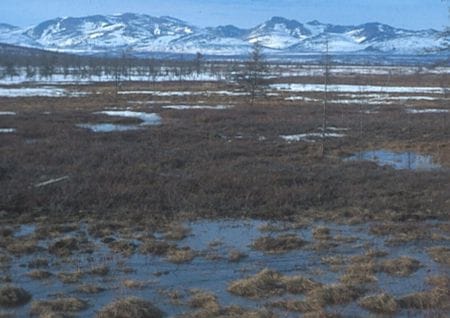
Biotic factors are living conditions that influence organisms and their evolution. These include animals competing for an organism's food, the influence of humans and how much food is available for an organism. Biotic factors that influence the tundra and affect the animals living there include vegetation, natural enemies, hunting by humans and food locations.

The plants of the tundra had to adapt to the strong winds and soil conditions. They therefore grow close together to minimise the influence of the wind and have a short growing season. In winter, tundra plants grow less and are protected by snow, which in turn means that the animals living in the tundra have less food available. Therefore, many animals in the tundra go into hibernation or migrate southwards. The animals take advantage of the warmth and abundance of food during the short growing season; they reproduce in summer and raise their young quickly.ß.
One of the largest predators in the tundra is the polar bear, whose role in the trophic level of carnivores in the Arctic tundra has created the external characteristics. Polar bears feed mainly on walruses, fish and seals. Over the course of evolution, their bodies have adapted to hunting these prey animals, which is why they can follow their prey over long distances and have a 10-centimetre-thick layer of fat to protect them from the cold in icy water. Polar bears have broad paws and claws that give them enough grip on the ice and resistance in the water when swimming.
Among the herbivores, musk oxen have prevailed. They feed mainly on grass and have two layers of fur: an outer layer of fur that reaches down to the ground and protects them from wind, snow and rain, and an inner layer of fur with warm hair. These layers of fur and their wide hooves enable the musk oxen to eat grass in one place for a long time without sinking into snow or mud.
The Arctic fox has a very thick pelt as protection against the cold of the tundra, which makes it a favourite prey animal for humans. Due to the hunting of the Arctic fox, some species are now almost extinct. To largely protect itself from its hunters, the Arctic fox's winter fur is white and its summer fur is brown.
The emperor penguin has adapted very well to the conditions of its environment. It has a thick layer of fat and is a good deep diver. The penguin's bones are massive and its heartbeat slows down during deep diving, thereby reducing its oxygen requirements.