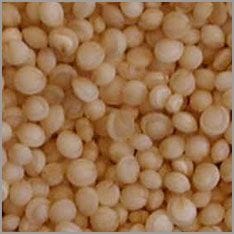
The name Amarante resonates for the majority of Europeans, very little, because it has not penetrated very deeply into our cuisines.

L'amarante is a grain like maize, which, however, does not belong to the family of céréales, but it has been placed there by commodity.
L'amarante comes from the Amérique du Sud, where it was considered a sacred plant by the Aztecs. They created this plant and used it mainly for religious purposes, firstly because they made a paste from the crushed grains together with other ingredients to form their personages, accentuated with rituals and human sacrifices. Since this horrifié les conquérants espagnols avec leur foi catholique, ils ont essayé d'interdire la culture et l'utilisation sout toute forme. The plant could only be protected from extinction by clandestine culture.
In modern-day Mexico, France, Peru and Bolivia, as well as in India and northern Europe, amaranth is still used today, and is a regular ingredient in some typical local platters and drinks, such as the Péruvian beer called "chicha" made with amaranth.
Les feuilles de la plante d'amarante peuvent être consommées comme légume, les graines peuvent être citées comme la préparation de boissons, mais aussi de confiserie faite d'elle.
Even its flowers have a positive effect and are used as medicinal plants to combat dehydration, but also in cosmetics, because they have a beautiful red colour that is very suitable for complexion bases and rouge à lèvres.
Although it is not officially one of the grains of amaranth, its preparation is just as versatile and simple as that of most cereals. Previously only available in most health food shops, you can get a whole grain of amaranth, or even in farine. It is therefore very versatile and can be used in combination with other types of farine or cereals, but can also be prepared on its own. L'Amarante can be rôtie, soufflé comme du maïs soufflé, germées, ou simplement cuites à l'eau. It is used in cakes, pastries and pâtisseries.
It is very mucilaginous, because it contains a lot of power (up to 60%) and lasts about 18-20 minutes, until it becomes thick, but it should not be cooked for longer, as it forms into a thick paste.
The flavour is delicate, slightly sweet and noisette and can be explained by ingredients such as bouillon and spices, which vary greatly.
Among the nutrients are fibres, vitamins A and C, iron, calcium, potassium and magnesium, as well as vitamin proteins and essential amino acids that our body desperately needs but cannot produce. The nutritional value of their actions is much better represented than in many typical platters for them, e.g. more calcium than milk, or more iron than milk.
Since the plant can be cultivated very easily, you can even plant it in your garden, it does not need special soil because it adapts very well and is easily attacked by parasites.
The only plausible reason for this is that it has not yet been discovered by local farmers, and they must be well aware of the fact that amarante is traditionally harvested on the farm and mechanical harvesting has not yet been restored. Nevertheless, amaranth is cultivated in certain states of the United States and enjoys growing popularity there as well.