You're just about to make a quick coffee and you're waiting for the water to heat up. But why does it seem to take longer when you watch the coffee machine?

It is indeed true that time passes more slowly or an event takes longer if you consciously wait for it, at least in the sense that your perception of time is distorted and the time it takes seems longer than it actually is.
The internal clock measures time in intervals. Depending on what you are doing, it measures time in smaller intervals (seconds) or larger intervals (minutes). This is very important for events that take place within a few seconds and important decisions have to be made. Before crossing a road, for example, the brain has to estimate how much time is left before the cars are too close. This is why certain events that require quick reactions also seem to take place in slow motion.
The nerve activity in the cortex vibrates when we perceive our surroundings; this rhythm is measured by the brain. The frequency of the vibrations is controlled, among other things, by how much you concentrate on something and how much you expect it. This is why the brain perceives more time for events that we are waiting for than actually passes.
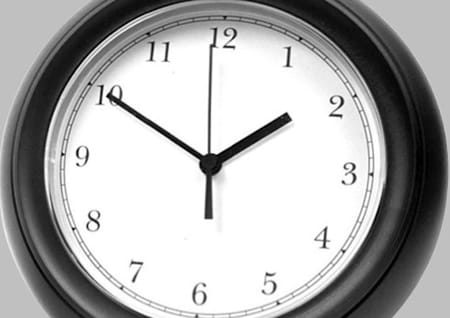
A similar principle applies to observing the second hand. If you concentrate on the second hand, it seems as if it takes longer than a second to move on.
This time delay really takes place in the brain's perception. In the time it takes to focus the eyes on the clock, the brain blocks out external vision in order to direct concentration to the centre of the field of vision. The time it takes to move the eyes from one fixed point to the next is added by the brain so that there is no visual gap in the consciously perceived field of vision. The time calculation of the internal clock therefore does not begin at the moment when the eye focuses on the fixed point, but goes back 50 milliseconds to the moment when you moved your gaze away from the last fixed point.