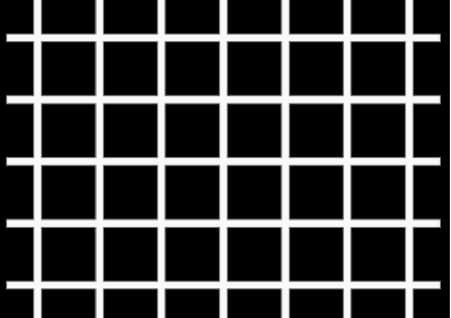
The lattice illusion is a physiological illusion. Other such illusions are afterimages after seeing particularly bright colours and lights or striking patterns. These are caused by prolonged stimulation of the optic nerve with a particular image.
The stimulus follows the nerves during image processing in the brain and this intense or repetitive stimulus trigger causes a physiological imbalance that impairs perception.
The lattice illusion can be explained biologically. Light and dark receptors trigger an inhibition of the neighbouring receptors. This inhibition triggers a contrast that emphasises the edges of the image. At the intersections of the white lines, the brain perceives grey patches that are not actually present. This is due to the contrast of the repeating black fields between white lines.