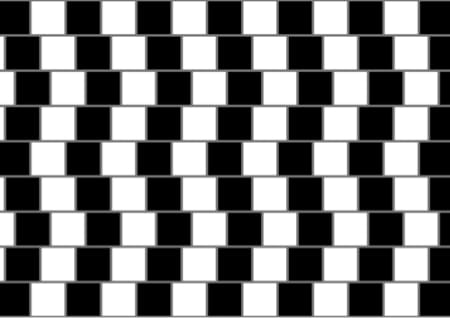
The coffee house illusion is a geometric optical illusion named after the wall pattern of a café in Bristol in the 1970s. In the pattern, the straight dividing lines between the alternating black and white rectangles appear to slope downwards or upwards.

This effect was discovered by Richard Gregory in 1973, or rather by one of his assistants (Steve Simpson) on the wall of the café. It is a variation of the Münsterberg illusion.
The pattern is composed of black and white "bricks", each surrounded by a layer of grey "mortar", the colour that is exactly between black and white. The illusion is mainly created by the light, or the incidence of light in the eye. If you replace black and white with other colours of the same luminosity, the effect disappears.