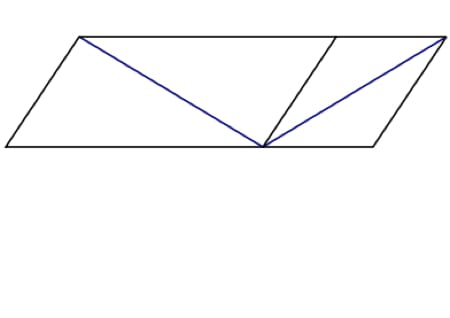
Sander's parallelogram is an optical illusion named after the German psychologist Friedrich Sander (1889-1971) in 1926. However, Sander was not the discoverer of this illusion; the parallelogram was published by Matthew Luckiesh as early as 1922.

The illusion is that the diagonal line that bisects the larger parallelogram on the left appears significantly longer than the line that bisects the parallelogram on the right. However, both lines are identical in length. One possible explanation for the optical illusion is that the diagonal lines around the blue lines create an impression of spatial depth, so that the blue lines integrated into this spatial depth are seen as being of different lengths.