The tradition of Christmas lighting has been around since the 17th century. Over the last 400 years, the idea of lighting lights and candles at Christmas time has evolved and defied the ravages of time. How did it all begin and what is the historical background behind the festive lighting?

As early as the 17th century, people decorated a fir tree for Christmas. In Germany, people then began to put small candles on the tree and light them at Advent. Over the years, the tradition of lighting candles spread to Eastern Europe. The idea is probably a continuation of the common Christian custom until then of placing a lit candle in the window so that everyone outside could see the light and know that Christians lived here. The burning candle symbolised that other Christians were welcome to enter and pray.
During Advent in 1880, Thomas Edison came up with the first electric Christmas lights. He displayed his Christmas tree lights outside his laboratory where any passer-by could admire them. This was not only the first electric Christmas lighting, but the first official Christmas display outside a house and not only on the Christmas tree.
A few years later, Edward Johnson, working under Thomas Edison's supervision, invented the first electric Christmas light chain. The string of lights consisted of 80 small light bulbs. As early as 1890, such fairy lights were produced commercially and department stores began to decorate their shop windows with Christmas lights. Decorating smaller shops became very popular in the USA at the beginning of the 20th century, thus opening the door to decorating private households with electric Christmas lights a few decades later, when mass production made them cheaper.
Due to the exclusivity at the beginning, electric Christmas lights initially remained a privilege of the rich. Those who could not afford the expensive Christmas decorations had to decorate the Christmas tree with real wax candles. This posed a considerable fire hazard, which is why people always kept buckets of water and sand ready next to the Christmas tree.
In 1895, American President Grover Cleveland donated electric Christmas lights for the White House. At that time, such lighting cost more than $300 per season, which would be equivalent to about $2,000 today.
In 1925, after devastating fires caused by Christmas trees in New York, the Sadacca brothers Albert, Henri and Leon founded a company that focused on making less dangerous Christmas lights possible for every household. This company (NOMA) became the largest supplier of electric Christmas lights and survived the Great Depression. It was not until 1968 that NOMA closed down due to competition.
However, we have NOMA to thank for the emergence of this competition, which meant that electric Christmas lights were no longer a privilege of the wealthy in the 1940s and 1950s, but that more households could afford a safe Christmas.
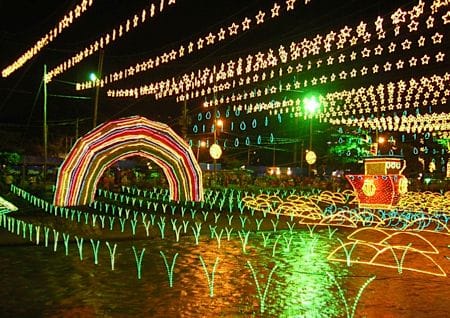
Nowadays, there are electric Christmas decorations with coloured lights and flashing. It has almost become a neighbourly competition to put up a bigger and brighter display during Advent. The lighting no longer has a religious background, but is meant to bring joy and light into people's hearts during the dark season.