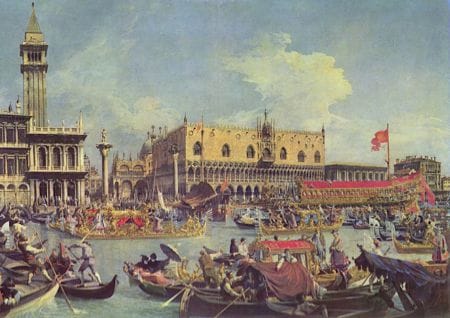
The Renaissance period developed at the beginning of the 15th century in Florence and was a rediscovery and reinterpretation of classical antiquity.
Around 100 years later, the Renaissance movement had spread throughout Europe.

The basic forms of classical antiquity were combined in the Renaissance with the newly discovered perspective, which enabled artists to reproduce drawing and mathematical rules for the representation of three-dimensional reality with scientific precision. This revolutionary discovery was particularly useful in architecture, as it enabled the artist to sketch a future building in a way that the viewer could understand.
The current meaning of art was born in the Renaissance period, as the artist was no longer regarded as an anonymous member of a guild, but as an intellectual personality. The assumption that a work of art must represent something also originally goes back to the Renaissance.
The Renaissance found application and significance in painting, architecture and sculpture.
How to recognise Renaissance painting
How to recognise Renaissance architecture
How to recognise Renaissance sculpture
Technical terms of the Renaissance