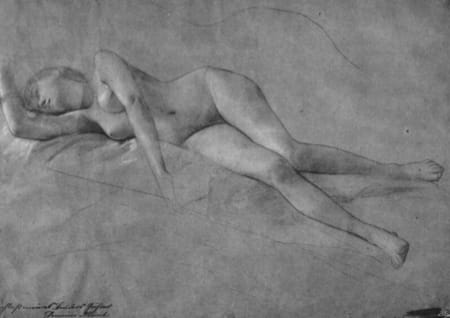
As the New Art stood for beauty and style, it was widely used in painting. The flowing lines of painting allowed ornamental abstraction, subtle colour, elegance and taste to be depicted in a particularly satisfying way. Optimism and frivolous joie de vivre became the ideal in the form of a beautiful, seductive woman. One of the most famous painters of this era was Henri de Toulouse-Latrec, who was a brilliant graphic artist. He was particularly fond of the poster, which was used as a new medium. Art Nouveau took the surface appeal and momentary impression of Impressionism and modernised it with dynamic lines, decorative ornamentation and artistic abstraction.

Art Nouveau painting tends towards the dreamlike, in which spatial depth and physicality do not play a major role.
One of the leading artists of Art Nouveau was Henry van de Velde from Belgium, who spent his life endeavouring to create contemporary art. He favoured bright colours and ornamental simplification. Unfortunately, his artistic development was interrupted by the First World War, which also affected Art Nouveau as a whole. In the times of hardship after the war, there was little need for expensive handicrafts. It was only after the Second World War that its international recognition began to rise again.
Born in Hamburg, Peter Behrens is one of the most important German Art Nouveau painters. His expressiveness also makes him a forerunner of Expressionism.
Gustav Klimt, an Austrian painter, embodied the purest form of Art Nouveau in his works. His paintings depict a tasteful beauty in which every emotion is transformed into enchanting ornamentation.