The art academies popular at the turn of the 20th century mostly taught sculpture in a conservative style. Students learnt how to create effective sculptures for funerary monuments, fountains and parks. At the same time, there was a great demand for decorative small-scale art in the form of small-format sculptures for upper-class salons. As Art Nouveau valued delicacy, linear extension and sensitive tension, particular attention was paid to small-scale detail. Art Nouveau small sculptures included wrought ironwork, medals, jewellery, church utensils, bronzes, cutlery, clocks, picture frames and ceramics.

Large-format sculptures were rather rare, as Art Nouveau focussed more on intimacy, dreamy beauty and mood. The aim of a sculpture was to enchant, so Art Nouveau sculptures have a rather restrained expression, in contrast to the loudness and forcefulness of Expressionism.
In France, artists were of the opinion that art must follow its own laws and not be a mere imitation of nature. The light-hearted and artistic attitude is therefore most evident in French sculpture. One of the most popular themes was the beauty of the female figure. The ideal conception was lively, dancing movements.
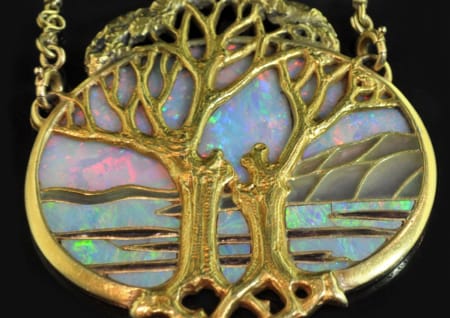
The French goldsmith René Lalique embodied the principles of Art Noveau at its purest. His jewellery pieces were of magical beauty made of the most precious materials, which harmonised wonderfully with the organic dynamics of Art Nouveau.