Communication between people is not limited to the words that are spoken. Often it is the unsaid that betrays a person's feelings.

A person's thoughts and feelings are also expressed through appearance and behaviour. Body language is difficult to suppress or simulate; if you know how to interpret body language, you learn much more about the other person's actual feelings.
Fear can be recognised in various ways in body language. Fear shows itself, for example, as fright or shock, as panic or also in a more defensive, submissive way.
In various professions, especially in solving crimes, it can be important to learn to interpret body language, especially fear. It can also help to assess the credibility of a witness. In daily life, recognising body language is useful in interpersonal relationships.
Head posture and facial expressions
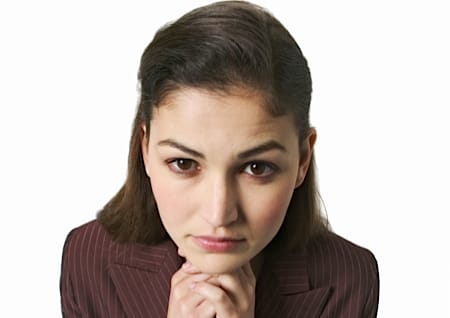
Fear and submissiveness is shown by a head tilted downwards. Often the fearful person plucks at his hair. A pale face reflects terror. Sometimes fear of the other person is also shown by a smile in which the eyes remain expressionless.
The anxious or fearful person avoids eye contact, the gaze is directed towards the floor, the environment or their own hands.
Signs of unease also betray anxiety. The eyebrows are furrowed or raised, the nostrils flared. The lips are either pressed together or bitten.
A fearful person may also fix their gaze on their counterpart, with the pupils dilated and unmoving.
Body and gestures
A fearful, defensive person crosses arms and/or legs and hunches their shoulders. This can be a sign that the person has a secret and is afraid it will come out. When a person crouches down, it can mean that they are unconsciously trying to appear smaller in order to appear less aggressive to other people.
If there is fear of punishment or physical harm, the person concerned either tries to run away or contracts into a ball. Conversely, there are people who tend to fight back out of fear and they make themselves visually larger to appear more threatening and deterrent.
An anxious person tries to increase the physical distance to other people by backing away or by trying to get a table or chair between them.
A typical symptom of anxiety is heavy sweating due to accelerated heartbeat and increased adrenaline levels. This is a natural, automatic reaction of the body in anxiety and stress situations.
Fear can often also be recognised by the position of the feet. A person who is afraid of someone or of the situation places his feet outwards or in another direction, an unconscious flight instinct.