Atmospheric optics effects around the sun and moon, such as the luminous ring, have fascinated people for centuries. Some enjoy the beauty of the phenomenon, while others draw conclusions about weather patterns and atmospheric stratification from it.
How is the ring around the sun and moon formed?
There are two types of rings that form around the sun or moon on some days. One type is called a corona (see below in the picture), aureole or halo. This phenomenon is a luminous phenomenon caused by diffraction of light by water droplets in the clouds.
The other phenomenon is called a halo (see picture above), and it is caused by refraction of light. The cause of this ring-shaped glow around the sun is sunlight or moonlight that is refracted when it shines through veil clouds (cirrostratus). The veil clouds are located at an altitude of about 7000 to 8000m and form from small ice crystals that spread out in a thin layer. They look like a veil and you can easily see the sun and moon through them.
In common parlance, the ring around the sun represents precipitation coming soon, usually rain is expected. In the summer months, the halo is a generally reliable, but not guaranteed, indicator that rain is coming within the next 12 to 24 hours. This is explained by the fact that cirrostratus clouds usually come before a warm front, which often brings rain.
The ring around the sun is usually perceived as a white glow, but it can also have the colours of the rainbow with red on the inside and blue-white on the outside. The sun and moon can both have a ring-shaped glow, but the rainbow colours are only seen in the sun. The halo effect has an angular extent of up to 22 degrees. Rarely, the Great Halo occurs with a radius of 46 degrees.
Halos around the sun and moon were recorded as early as Constantine's time in the 4th century. However, it is unclear when this light phenomenon was associated with weather forecasting.
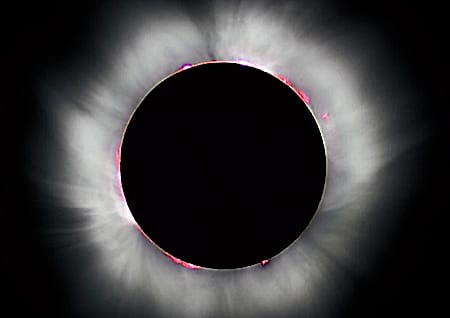
Corona around the sun, clearly visible during solar eclipse.