The meaning of a dragon tattoo is complex. Depending on the type and design of the dragon, there are different meanings that a dragon symbolises.

In Western cultures, a dragon is usually evil, while in Eastern culture, a dragon is considered wise and good and even a good luck charm. For many people, a dragon tattoo represents qualities that the wearer desires or aspires to for themselves, namely qualities such as loyalty, perseverance, power, wisdom, exceptionality and magic.
Also, the meaning of a dragon tattoo changes according to the gender of the wearer. On a woman, the dragon tattoo often represents a flowing elegance that hides the woman's true strength. Women usually see a dragon as the patron saint of life, representing inner and outer strength.
Usually a dragon tattoo on women is found on the shoulder, side, neck, upper back or ankle or foot.
In men, a dragon represents courage, power, wisdom and protective qualities; all qualities that many men strive for, seeing themselves as the protector of the family. Men usually wear a dragon tattoo on their shoulder, back, arm or leg.
Dragons are mythological creatures that are both impressive and frightening. The dragon is depicted as a winged beast with huge claws and scales that breathes fire from its mouth. Typical dragon designs are the Celtic dragon, the Japanese dragon, the Chinese dragon, the tiger dragon and the tribal dragon.
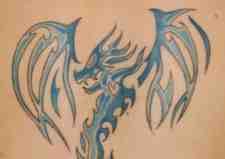
The Celtic Dragon Tattoo
The Celtic dragon is depicted differently on different parts of the body. On the back it is often larger, on the arm or leg it can form a ring or coil like a snake from the bottom to the top. The Celtic dragon tattoo is very complex and has typical features such as sharp teeth, scaly skin and fiery eyes. It is depicted as breathing fire.
The modern tattoo stands for courage and power, as it did in the Middle Ages. It is seen as a symbol of evil. The tattoo is nowadays taken to represent a dark quality in the wearer and has lost its original association of the dragon with the healing powers of nature.
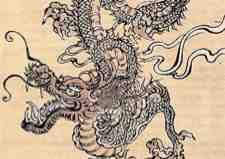
The Japanese Dragon Tattoo
In Japan, a dragon signifies balance between yin and yang. Dragons are frequently represented in Japanese mythology, they are even considered a water deity. Japanese dragon tattoos are often depicted together with clouds. There is a legend in Japan that the first ruler of Japan was a descendant of dragons. Often Japanese dragon designs are a symbol of the protection of the royal family. Characteristically, the Japanese dragon has no wings and a serpentine body. Its head resembles a camel, its paws a tiger and its claws those of an eagle. It has long whiskers and a gemstone under its chin. In Japan, a dragon tattoo symbolises power, family, protection and long life. Different Japanese dragons have different meanings. Sui-Riu is the king of dragons who controls rain. Han-Riu is the largest of all dragons and he has a striped body. Ka-Riu is a small dragon of reddish colour. Fuku-Riu is a lucky charm.
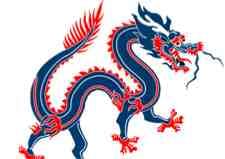
The Chinese Dragon Tattoo
In Chinese culture, dragons are masculine and are associated with the largest digit, the digit 9. Chinese dragon tattoos symbolise intelligence, strength, luck, health and harmony. Like the Japanese dragon, the Chinese dragon is associated with rain. Chinese dragon tattoos have a flaming pearl under the chin, a snake-like body and scales. They are said to possess supernatural powers. A horned dragon symbolises power in both words and actions. The earth dragon is the ruler of the earth and represents the connection between with earth and land. The yellow dragon is a hornless dragon and represents knowledge. The celestial dragon protects the gods. The wearer of the celestial dragon tattoo follows a spiritual path and has a strong faith.
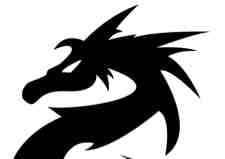
The tribal dragon tattoo
A tribal dragon is surrounded by or consists of curved lines. The design is simplified and often monochrome. Despite the unified representation, the dragon does not lose its impact. In fact, it usually looks rather fearsome. The meaning of the tribal dragon tattoo depends on the tribal art with which the dragon is combined.
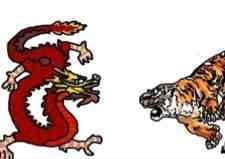
The Tiger Dragon Tattoo
In oriental culture, the dragon is considered the defender, the tiger the attacker. If the dragon is placed on the tiger, this symbolises a victory over the dark forces. The dragon continues to serve as the defender. If tiger and dragon are depicted fighting with each other, this stands for the inner aggressiveness of the wearer in connection with disregard and lack of respect for other people and their belongings. If dragon and tiger are on the same level, this resembles the yin and yang symbol and stands for the balance of contradictory powers.