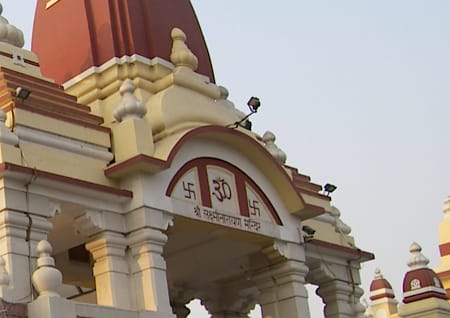
Travellers to a Hindu country for the first time can get a fright when they see swastikas everywhere. The Nazi swastika is actually based on the original Hindu swastika. On closer inspection, however, you realise that the two, with such different meanings, are not the same at all.


Swastika
The swastika is the second most important symbol of the Hindus and dates back at least 3000 years. Different cultures used the ancient sun symbol; it was found among the Celts in northern Europe, the Greeks as early as 1000 BC and in India.
The visual difference between the Hindu swastika and the swastika of the Third Reich is the angle. The swastika appears to be on the lower beam of a hook, while the swastika is rotated 45 degrees and is on the top of the hook.
In India, there are two forms of the swastika, one right-handed and one left-handed. The left-handed symbol is "mirrored", i.e. the hooks point to the left. The left-handed swastika is associated with esoteric tantra practices, or is used by Buddhists, Jainas as well as in the Theosophical Society of Hindu groups.
The right-handed swastika is mostly used in Hindu temples, private homes and ceremonies as a symbol of good luck, health and prosperity.

Swastika
As the swastika from Nazi Germany, this symbol is now a symbol of racism, persecution and anti-Semitism. Hitler did not invent the symbol at all, but merely copied and slightly modified it. Due to its association with the Nazis, the swastika has unfortunately taken on the meaning of destruction of life in the Western world and thus stands in stark contradiction to its original affirmation of life.