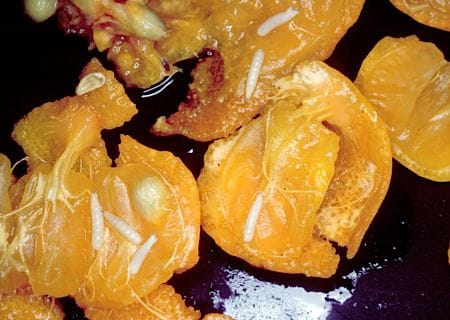
As temperatures rise in summer, the food and breeding opportunities for fruit flies also increase. These annoying little flies have a lifespan of just one month, during which a single female fly can lay up to 700 eggs. In winter it takes around 70 days for the eggs to develop into new flies, but in summer this often happens in just one week.

Fruit flies feed on any kind of fermented liquid. Overripe fruit and vegetables are therefore particularly attractive to them. The fruit flies feed on the fruit and lay their eggs there. Once the eggs have developed into flies, they transfer fermentation substances to the surrounding fruit and vegetables, causing them to rot more quickly.
The only way to get rid of fruit flies is strict hygiene in the home and garden. Overripe fruit should be removed immediately and either utilised or disposed of.
As long as it is hot, it is better to store fruit and vegetables in the fridge.
Organic waste should be disposed of once a day in the appropriate waste bin.
Fruit flies can also be found in the sink drain or in damp dishwashing sponges. Both the sink and the sponge should therefore be disinfected regularly.
To eliminate an existing fruit fly nesting site, the area should be thoroughly scrubbed with boiling water and vinegar.
A trap for fruit flies
If fruit flies occasionally accumulate despite hygiene and caution, they can be lured into a trap relatively easily. To do this, pour vinegar into a glass and cover the glass with a funnel, the thin end facing upwards. The vinegar acts as an attractant for the flies, which will then be unable to find their way out through the thin end of the funnel. Tip out the vinegar every day and replace it with new vinegar.