Alongside the guitar, the piano is one of the most popular instruments.

Whether you are interested in classical or modern pop music, the piano is versatile.
Find out more about the piano and how to learn to play it here. If you follow the steps correctly, you can easily teach yourself to play the piano in a short time.
If you want to learn to play the piano, remember that it should be fun. Practise as long as you feel like it. If you get frustrated, stop for the moment and come back to the piano later when you're in the right mood.
Piano or keyboard
The classical piano has 88 black and white keys. Although a keyboard is constructed in the same way as a piano, it often has fewer keys and therefore a smaller range. However, this is completely sufficient for most pieces. The keyboard can also be used to create many different sounds and effects.
Many choose the keyboard instead of a piano for reasons of space or for the sake of the neighbours, as it can be turned down or played through headphones.
The touch of the keys on the classical piano is harder and more sonorous than on the keyboard and is therefore more "real" for many people.
For someone who is not yet one hundred per cent sure that the piano is the right instrument for them, it is definitely advisable to buy a simple keyboard that doesn't cost as much and takes up less space.
The most important elements of playing the piano
The best starting point for familiarising yourself with the keys and the notes they represent is middle C. Your piano or keyboard has a row of white keys interrupted by groups of two or three black keys. The white key to the left of the first group of two black keys is called C. On a standard keyboard, the fourth C is the middle C.
Once you have identified middle C, you can now easily find all the other whole tones. Whole tones are the white keys on the piano. Moving from the C key to the right, you will find the notes D, E, F, G, A, B and then the next higher C.
The step from one white key to the next white key is called a whole note if there is a black key in between. You will notice that E and F, B and C do not have a black key between them, as they are only half a note apart.
Black keys move the note half a step up or down. If a whole note goes up half a step, an - sharp is added to the end, i.e. C becomes C sharp, D becomes D sharp, F becomes F sharp, G becomes G sharp, A becomes A sharp. These notes are symbolised with the sign # (C#, D# etc.). If a whole note goes down half a step, an -es is added to the end, i.e. D becomes D flat, G becomes G flat, A becomes A flat or A flat, but B becomes B flat. These notes are symbolised by a b (Db, Gb, Ab).
You may notice that not all notes have been mentioned. This is because some # notes are identical to b notes.
Whole E = Fb
Whole F = E#
Whole H = Cb
Whole C = H#
Differentiation between whole and half notes
There are different ways to find out whether the notes you are playing are whole, # or b. Firstly, there is a # or b symbol on the sheet of music between the clef and the bar if a certain note is to be played as a half note throughout the entire piece. For example, if there is a # on the C line, a C will be played as a C sharp throughout the entire piece unless it is marked once again as a C by a cancellation sign.
If there is a b on the B line, for example, the B is played through the whole piece as a b, as long as no cancelling sign is used.
There can also be several signs at once, in which case all the marked notes must be played accordingly.
The other option is to mark a single note within the piece with # or b if this is only to be converted to a semitone once.
All unlabelled notes are whole notes.
Read sheet music
Some people are able to play music by ear. If you are not one of them, you should definitely learn to read music.
Generally speaking, there are five lines in a row. The middle C is on an imaginary auxiliary line below the bottom line. From there, count the whole notes D E F G A H C etc., with one note on the line and one note between the lines. If you now count through all the whole notes, the note on the top line is a G, a high G.
The translation of the symbols on the sheet of music
You can only improve your playing by constantly practising. Be patient with yourself if some things don't work right away. The recipe is to only practise when you are in the right mood.
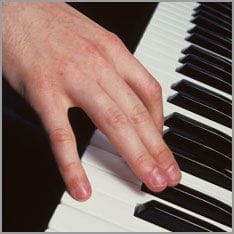
At the beginning, it is best to start with one hand, the right hand. The right hand plays the melody. Later you can add the left hand for the accompaniment when you are more confident.
Take lessons
It would go beyond the scope of this article to go into too much detail. This report is intended as a suggestion. If you want to learn more, such as scales or the finer points of piano playing, you should take piano lessons.
However, lessons put some people off and turn a hobby that should be fun into a chore. If you only want to play for your own pleasure and according to your own feelings, it is perfectly sufficient to teach yourself how to play the piano. This way you are guaranteed to be able to play what you want.
So have fun making music!