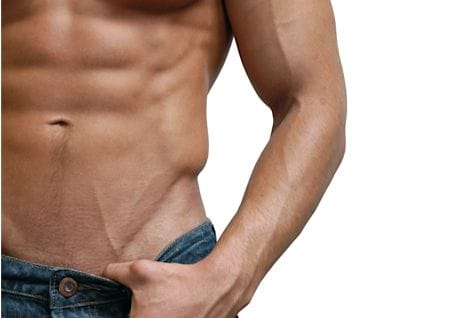
Everyone wants a flat stomach, or even better, the famous washboard stomach or six-pack. The adverts promise us that it is possible to get the toned super-body we want in no time at all with just a few minutes' effort a day or even a fat-burning tablet. But are these promises realistic? This is how you can actually train your abdominal muscles.

The abdominal muscles are located in the centre of the body. They consist of the transverse abdominus, rectus abdominus and inner and outer muscle strands. The transverse abdominus is a deep muscle that wraps around the entire abdominal area and stabilises the upper body. The outer and inner muscle cords help the body to twist and bend to the sides. Between these and the transverse abdominus is the rectus abdominus, which is divided into sections. This is what gives a well-trained body the washboard look.
Well-trained abdominal muscles are not only aesthetically pleasing, but also support balance and posture and prevent back pain. The abdominal muscles are the centre of the body, and when the core is strong, it supports the rest of the body in daily activities.
Targeted abdominal training is important in order to train the abdominal muscles successfully, but the sport should consist of a variety of different movements. You cannot train the large abdominal muscle effectively with just one exercise. Training should consist of a series of exercises that you make into a routine. Also, you can only get washboard abs if you are already within a weight class. For the perfect washboard abs, men need to get their body fat below 10% and women below 15%. Depending on the intensity of the training, you will usually only see results after 4 to 8 weeks. If you already have a body fat content of 10 or 15%, have been exercising regularly for some time and have started targeted abdominal muscle training, you can actually see the first definition of your six-pack after two weeks. Otherwise, you first have to do the groundwork and invest time and effort.
To reduce body fat, you need to control your diet and also do endurance training for 45 minutes on at least 5 days a week. Swimming, cycling, treadmill, jogging and aerobics are all good options. You should not lose more than one kilo per week, as excessive, sudden weight loss is unhealthy and a shock to the body.
You don't necessarily need expensive equipment to train your abs. Push-ups, sit-ups, weight lifting etc. can define the desired abdominal muscles with perseverance and regularity. Newcomers should start slowly and gradually increase the exercises.
Weak abdominal muscles are initially unable to lift their own body or other weights, which is why many people try to compensate for this weakness by placing one-sided strain on other parts of the body. When doing sit-ups, many people clasp their hands behind their head and pull their upper body up using the strength in their neck. This results in neck pain and prevents effective abdominal muscle training. Care must therefore be taken to perform the exercises correctly and only go as far as the respective capacity limit of the muscles until they are gradually strengthened. This prolongs the overall duration of the training for an untrained body and makes it impossible to achieve the goal in just two weeks, but is much healthier and has a long-term effect.
You can also train well with a medicine ball, which is clamped between the legs during sit-ups, then passed to the hands, with arms and legs being lowered back to the floor at the same time.
You should also not forget the lateral muscle strands. These can be trained with stretching and twisting exercises. Here, too, you can continue working with the medicine ball later on to intensify the work of the muscles.
The number of exercises should be limited. You don't need to do hundreds of sit-ups to get washboard abs. It is better and healthier to do two or three sets of 15 to 20 repetitions each. If you feel that the exercise is not effective, it is either too easy or performed incorrectly. The more repetitions you do of an exercise, the more you tend to utilise the momentum and use less muscle strength. An exercise is effective if you feel the effect after 20 repetitions at the latest.
For inexperienced people, it is often advisable to seek professional advice from a trainer at the gym. The trainer ensures that the exercises are performed correctly and suggests specific exercises to achieve the desired goal.
Notes:
Always start slowly and listen to your body.
Warm up the body before the muscle exercises to avoid strains.
Have patience: Developing muscles takes time and perseverance.
If done correctly, you should never feel any back pain.
If you experience neck or back pain, you should work with a trainer.
Exercises that cause pain should be stopped immediately.