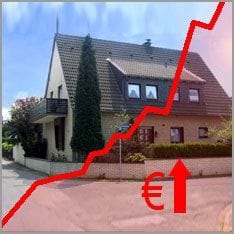
If you have a house or a plot of land to sell, many people often ask themselves whether it is better to consult an estate agent or not. Sure, the estate agent has a lot of customers, but they also pocket a large portion of the purchase price as commission. And there are also customers who deliberately don't want to go through an estate agent so that they don't feel they are paying too much.

So both have their advantages and disadvantages. However, you must be prepared to do a little more work for the money you save. Continue reading.
A property that sells for €300,000 costs the seller and the buyer €10440 each with a 3.48 % per cent brokerage fee (usually payable by the seller plus another 3.48 % payable by the buyer). After all, that's a lot of money.
You could of course increase the price of the house by €10,000 so that you are still left with the same total profit, but many potential buyers know this and push the price down or don't even look to an estate agent. So you decide you'd rather sell your house on your own and put up a sign, "Direct sale by owner", attracting people who in turn want to save the €10,000.
Before you put the house on the market, you should make it as attractive as possible for the potential buyer. First impressions count. That means it's most important that it looks tip-top from the outside. The general rules are:
* No rubble or rubbish should be lying around
* The lawn should be mowed
* The fence painted or cleaned
* Do not leave a car parked in the driveway
Similar rules also apply to the interior, of course, but only secondarily. A house that looks well-kept on the outside and run-down on the inside looks to the buyer like a valuable house that needs a bit of care on the inside. Conversely, a run-down house on the outside with a freshly renovated interior looks like an unkempt old house that is in good shape on the inside.
Inside, you shouldn't overdo it and leave the personal touch. This makes the living space look more appealing.
It is not advisable to cover up major problems such as a crack in the wall, as the buyer will inevitably see this. If you don't have it repaired before the sale, it's better to bring it to the buyer's attention directly before they try to negotiate the price down because of it.
If you are currently living in the house you are thinking of selling, don't forget to complete the necessary formalities with the bank for the purchase of a new home before the sale in order to speed up the transition phase. After all, you don't know how quickly your home will sell.
This also applies to the purchase of your new home. Look around in good time and be clear about what you want to look for.
As for the sale value of the house, do some research on what similar properties are selling for in your area. The rule of thumb is that properties double in value in 10 years. That's a strong generalisation, but it's a guide. So if you bought your house 15 years ago for €200,000, it should now be worth around €500,000 if it's in similar condition. As I said, you should still check what your neighbouring properties are currently on the market for.
Calculate in advance how much money you will have to pay back to the bank if the house is still mortgaged, and how much you will realistically have to spend on fees, taxes and legal fees so that you end up with a profit.
Your selling price also depends on how urgent you are to sell. The more in a hurry you are, the more you can offer it as a "bargain" below the market price. If you are not in such a hurry, keep the price realistic.
Now let's move on to advertising. You should definitely put up a sign in front of the house, statistically this is the most effective. Spend a little more here than on a piece of cardboard, as this is also part of the 'first impression'. Nowadays it doesn't cost much to put up a digital print of an appropriate size. It looks more professional.
Newspaper advertising has now been overtaken by the Internet. It costs a maximum of €25 per month (cheaper for longer periods) to advertise the property on sites such as ImmobilienScout24.de, which has high customer traffic. The estate agent usually uses the same method and finds the same customers. You can also describe your property better on the Internet and include photos.
Since you have to show the prospective customers around yourself, you should orientate yourself to the customers, not the other way round. Don't keep customers waiting for long, otherwise you will become impatient.
Leave the interested parties largely alone when viewing. Only be available to answer questions. Salespeople who are too pushy will put your customers off. Nobody wants to feel pressurised.
A seriously interested customer will most likely want to come to view the vehicle several times and may also want to bring an expert with them. Be prepared for this. When it comes to negotiating the final price, it's up to you how flexible you are. Perhaps set the price a little higher than what you want so that you can accommodate the buyer. But don't be too greedy, because if the house looks cheap, many buyers won't even start negotiating.
Once you have found a buyer, it is best to conclude a preliminary contract. Talk to your lawyer about this. It's better to be on the safe side and invest a little more.
After that, it's only a matter of time before you meet again at the notary and sign the official purchase contract.
Now you can pat yourself on the back.